

 EN
 русский
 Español
 عربى
 Français
Two-Person Outdoor Portable Toilet: A Practical, Hygienic, and Rapidly Deployable Sanitation Solution
Admin 2026-09-15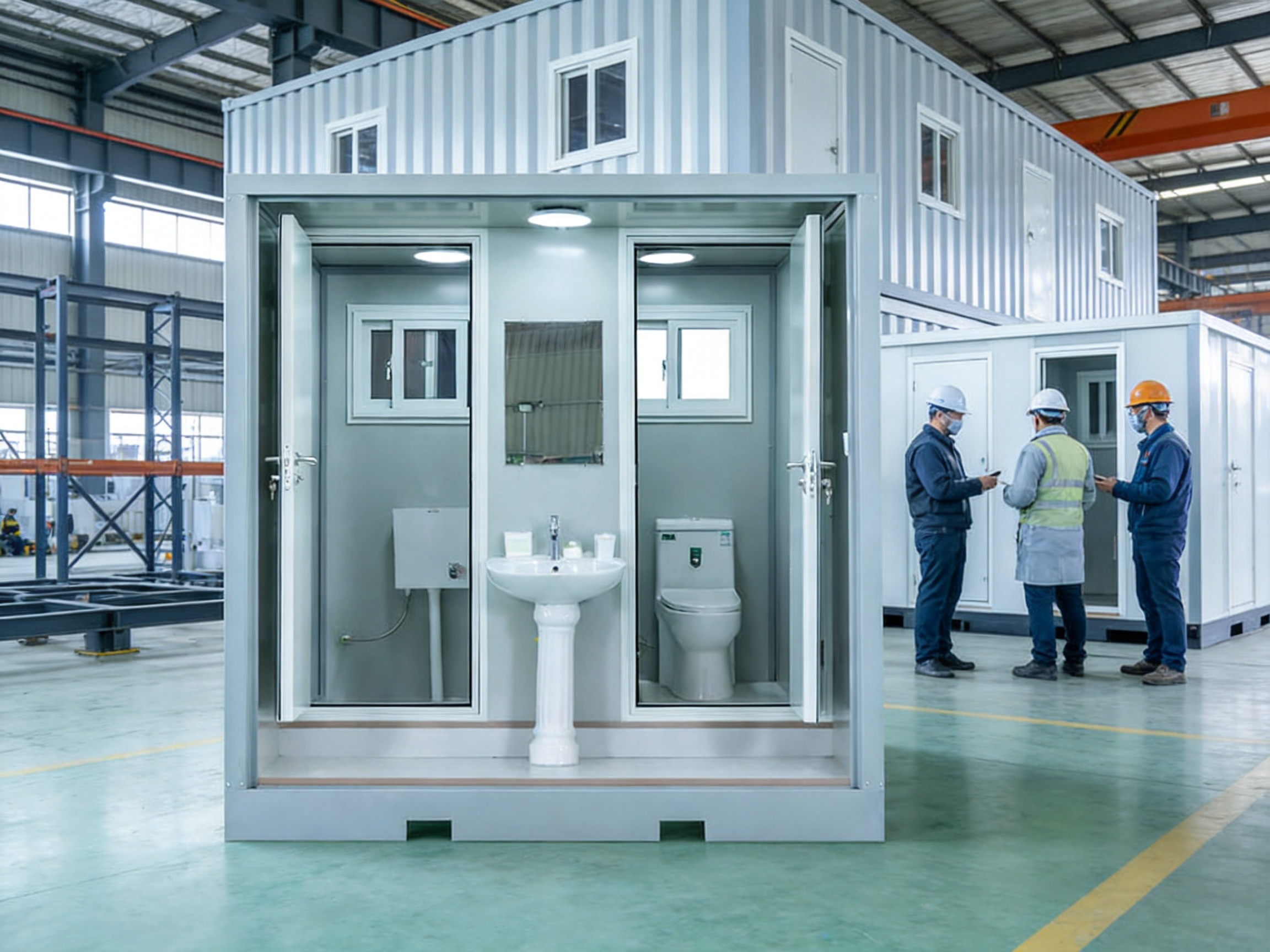
Reliable sanitation is one of the most important requirements at outdoor events, construction sites, temporary accommodation areas, campsites, public gathering spaces, and emergency-response locations. When permanent restroom facilities are unavailable or cannot be built quickly, a portable toilet must provide more than basic functionality. It should offer privacy, hygiene, durability, user convenience, easy transportation, and rapid deployment while remaining suitable for demanding outdoor conditions.
The Two-Person Outdoor Portable Toilet is designed to meet these requirements in a compact and efficient format. It combines separate male and female compartments, an external handwashing sink, built-in lighting, and a robust mobile structure in one ready-to-use unit. Unlike a single-compartment portable toilet intended for short-term individual use, this solution is organized to support multiple users while improving privacy and managing visitor flow.
It is suitable for construction projects, festivals, outdoor exhibitions, sports activities, camping areas, disaster-relief operations, temporary worker facilities, and other situations in which sanitation infrastructure must be installed quickly. Its pre-assembled design also reduces the amount of work required at the destination, helping operators establish a functional restroom area without conventional construction delays.
The unit is manufactured by Suzhou Taimao Integrated Housing Co., Ltd., a China-based integrated housing and modular building manufacturer with experience in prefabricated structures, portable buildings, temporary housing, container houses, and modular construction systems. The company’s wider manufacturing capabilities support a product-development approach focused on factory-controlled production, standardized components, practical installation, and dependable delivery.
Content
- 1 Why Portable Sanitation Requires a Better Design
- 2 Product Overview
- 3 Main Advantages of the Two-Compartment Configuration
- 4 Built-In Lighting for Day and Night Operation
- 5 Outdoor Durability and Relocation Capability
- 6 Pre-Assembled Construction and Rapid Deployment
- 7 Comparison with Common Portable Restroom Alternatives
- 8 Applications Across Different Industries
- 9 Manufacturing Strengths Behind the Product
- 10 Material and Structural Considerations
- 11 Hygiene, Cleaning, and Maintenance
- 12 Installation and Site Planning
- 13 Customization and Project-Specific Requirements
- 14 Operational Value for Contractors and Facility Managers
- 15 Environmental and Resource Considerations
- 16 Quality and Safety Priorities
- 17 How to Select the Right Portable Restroom Supplier
- 18 Why Choose an Integrated Modular Manufacturer
- 19 Frequently Asked Questions
- 19.1 What is the Two-Person Outdoor Portable Toilet?
- 19.2 Does the unit include separate male and female areas?
- 19.3 Is the portable restroom delivered pre-assembled?
- 19.4 Can it be used at night?
- 19.5 Does it include a handwashing facility?
- 19.6 Can the unit be relocated?
- 19.7 Where can the unit be used?
- 19.8 Is the unit suitable for permanent use?
- 19.9 Can the design be customized?
- 19.10 What makes it different from a basic single portable toilet?
- 19.11 How should the product be maintained?
- 19.12 What information should be provided when requesting a quotation?
- 20 Conclusion
- 21 References
- 22 Product: Two-Person Outdoor Portable Toilet
Why Portable Sanitation Requires a Better Design
Outdoor sanitation requirements vary widely. A construction site may need a restroom that can withstand dust, repeated relocation, and intensive daily use. An event organizer may require a clean and visually acceptable facility that can be placed near a busy public area. A disaster-relief team may need a unit that can be transported to a remote location and made operational with minimal tools and preparation.
Traditional permanent restrooms are not always suitable for these conditions. They require foundations, utility connections, excavation, architectural planning, drainage work, and extended construction schedules. Even lightweight temporary structures may require several separate components, including partitions, lighting, plumbing, washing stations, and electrical installation.
Basic single-stall portable toilets solve part of the problem, but they may provide limited privacy, insufficient capacity, or no handwashing function. They can also be inconvenient where male and female users need separate facilities. When numerous single units are placed together, the total footprint, maintenance workload, and logistics requirements may increase.
The Two-Person Outdoor Portable Toilet addresses these limitations through an integrated layout. Its two independent compartments create a clear distinction between male and female facilities, while the external handwashing sink supports hygiene immediately after use. Built-in lighting improves usability during evening operations and in locations where grid-powered illumination is not available.
By combining these elements in a single portable structure, the unit provides a more organized alternative to scattered individual toilets. It is intended to deliver the essential functions of a small temporary restroom in a compact, manageable, and rapidly deployable form.
Product Overview
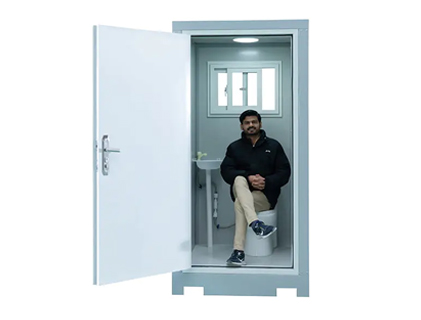
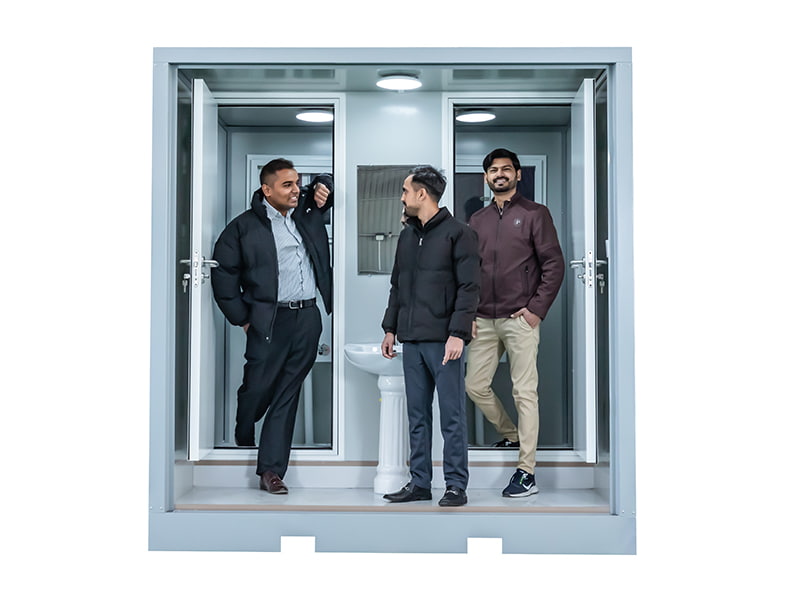
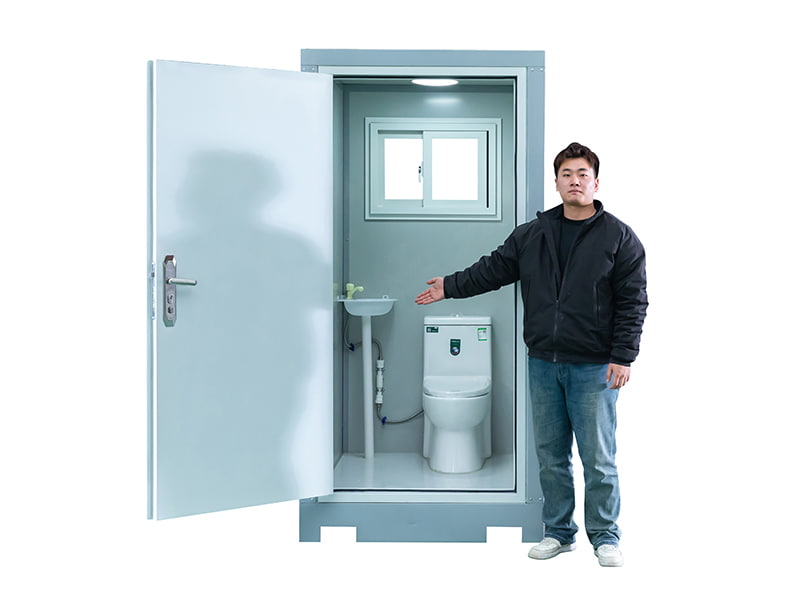
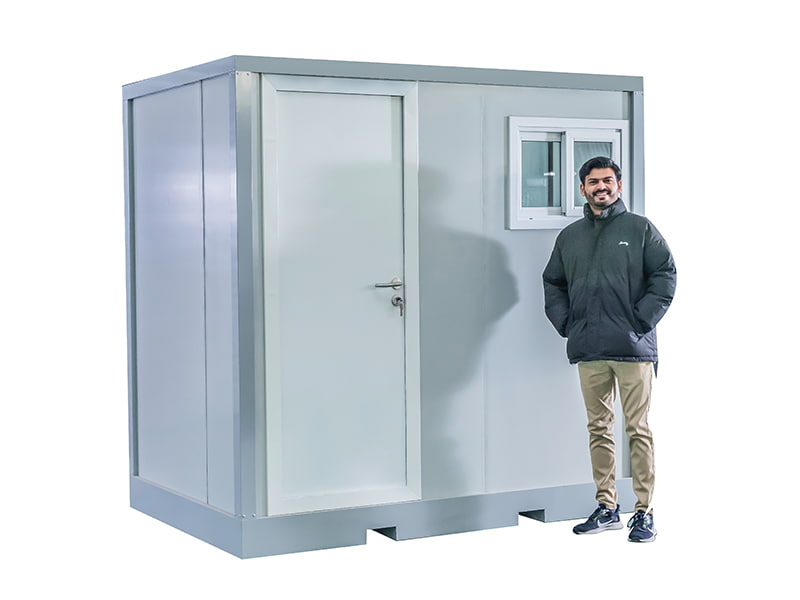
The Two-Person Outdoor Portable Toilet is a mobile restroom facility designed for outdoor and temporary applications. It includes two separate restroom compartments, each intended to provide individual privacy. The external washing station is positioned to encourage hand hygiene without requiring users to enter a separate washing area.
The structure is pre-assembled before delivery, allowing the customer to reduce on-site installation work. Depending on the selected site conditions, utility arrangement, and project requirements, the facility can be incorporated into a broader temporary infrastructure plan. It can be positioned at construction sites, outdoor venues, camps, emergency shelters, roadside service areas, or other locations where sanitation access is needed.
Its key functions include:
Separate male and female compartments for improved privacy and organization.
Built-in lighting for use at night and in low-light conditions.
An external handwashing sink to promote hygiene and convenience.
A robust structure designed for outdoor exposure and frequent relocation.
A pre-assembled configuration that supports fast deployment.
A portable format suitable for temporary, seasonal, and emergency applications.
The design is intentionally practical. It does not attempt to replace a large permanent public restroom building. Instead, it provides a focused solution for situations where operators need dependable sanitation facilities without waiting for a conventional building project to be completed.
Two-Person Outdoor Portable Toilet
Main Advantages of the Two-Compartment Configuration
Improved Privacy
Privacy is one of the most important factors in public and temporary restroom design. Separate male and female compartments allow users to access facilities that are organized for their needs rather than entering a shared interior space. This arrangement is particularly valuable at public events, worksites, temporary settlements, and family-oriented outdoor locations.
Compared with an open or multi-user temporary arrangement, independent compartments help create a more comfortable experience. They also simplify site planning because the operator can identify the intended use of each area without installing additional internal partitions after delivery.
Better User Organization
A two-compartment layout supports clearer user flow. Visitors can identify the appropriate restroom quickly, reducing confusion at busy venues. For construction managers and site supervisors, the arrangement provides a straightforward facility that can be placed near work zones while maintaining an organized site layout.
At festivals and outdoor activities, user organization can contribute to shorter waiting times. Although actual capacity depends on user behavior, event attendance, and the number of units provided, a dual-compartment design offers a more efficient starting point than a single isolated stall.
More Efficient Use of Space
Instead of transporting and positioning multiple unrelated portable facilities, an operator can use one coordinated unit with two compartments. This may simplify site preparation and reduce the number of individual objects that must be positioned, inspected, cleaned, and moved.
A compact combined unit can also be useful when available site space is limited. Construction projects, temporary markets, camping grounds, and emergency areas often need to balance restroom access with roads, work zones, pedestrian routes, storage areas, and safety clearances.
Integrated Hygiene Support
The external handwashing sink is a major functional advantage. A restroom without a nearby handwashing facility may not sufficiently support hygiene, especially in environments where users are handling food, working with construction materials, or sharing facilities with large groups.
By placing the sink outside the compartments, the unit provides a visible and accessible hygiene point. It can help operators establish a more complete sanitation routine and may reduce the need to install a separate handwashing station nearby. The sink also makes the facility more suitable for events and public areas where hygiene expectations are high.
Built-In Lighting for Day and Night Operation
Outdoor facilities are often used beyond daylight hours. Construction shifts may begin early or finish late, events may continue into the evening, and emergency conditions can occur at any time. Without adequate lighting, restroom access becomes less convenient and may create safety concerns around entrances, pathways, and washing areas.
The Two-Person Outdoor Portable Toilet includes a built-in lighting system. This feature improves visibility inside the facility and supports more reliable use during nighttime or low-light conditions. It also reduces the need for temporary lamps or separate lighting fixtures to be installed after delivery.
Integrated lighting offers several practical benefits:
Users can identify entrances and internal areas more easily.
Operators can reduce dependence on temporary portable lamps.
The restroom remains functional during evening work shifts and nighttime events.
Low-light deployment becomes easier in emergency and remote locations.
Site managers can plan a more complete facility installation from the beginning.
The specific electrical arrangement should be confirmed according to the project’s power supply, climate, local regulations, and customer requirements. For locations without a permanent grid connection, the operator may coordinate the lighting system with an appropriate temporary power source.
Outdoor Durability and Relocation Capability
A portable restroom must be able to tolerate outdoor exposure. Rain, wind, dust, sunlight, temperature changes, repeated cleaning, and frequent handling can all affect the service life of a temporary structure. A unit designed only for indoor conditions may quickly become unsuitable when placed on an open construction site or exposed event ground.
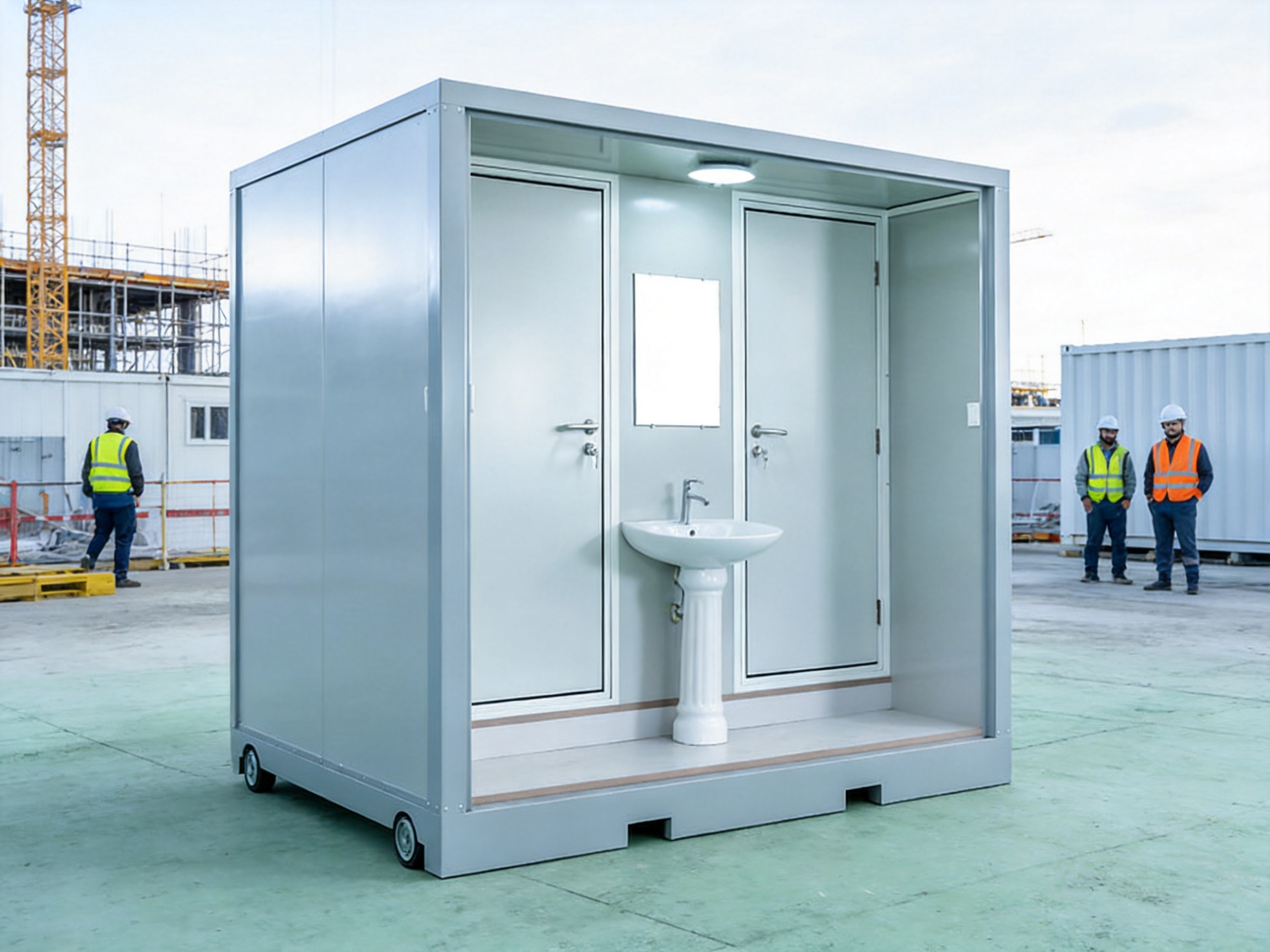
The Two-Person Outdoor Portable Toilet uses a robust and stable structure intended for outdoor use. Its design emphasizes practical durability and the ability to withstand frequent relocation. This makes it appropriate for businesses and organizations that use temporary facilities across different projects or move them as a worksite develops.
Relocation capability is especially valuable in the construction industry. As a project progresses, work zones may shift, roads may be reorganized, and different teams may occupy different sections of the site. A fixed restroom building may become inconvenient or inaccessible, while a portable unit can be repositioned to remain close to active work areas.
Event organizers also benefit from mobility. A unit may be used at one festival, transported to a sports field the following week, and later deployed at a public works project. The more flexible the facility, the greater its potential value over its working life.
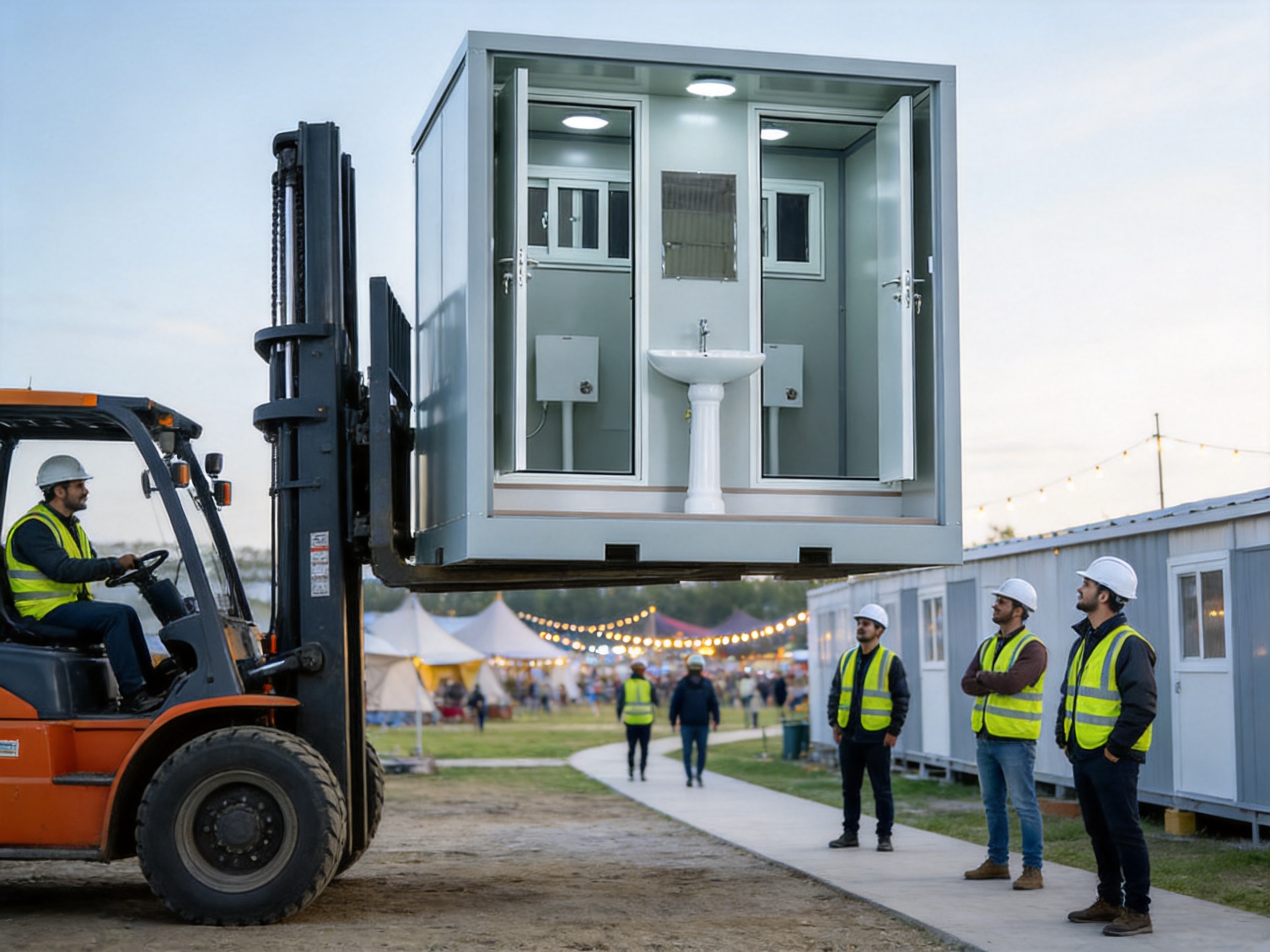
Although the structure is designed for mobility, proper handling remains important. Site operators should use suitable lifting, loading, transport, and positioning procedures. The ground should be stable and reasonably level, and local safety requirements should be followed during placement and relocation.
Pre-Assembled Construction and Rapid Deployment
One of the most significant advantages of the product is its pre-assembled delivery format. Conventional restroom construction can require architectural planning, material procurement, foundation preparation, plumbing installation, electrical work, interior finishing, and inspection. These activities may be appropriate for a permanent facility but are often excessive for a temporary application.
A pre-assembled portable restroom reduces the amount of work needed on site. Once the unit has been delivered and positioned, the customer can complete the necessary utility and operational preparations according to the project configuration. This helps shorten the period between delivery and use.
Rapid deployment is particularly important in the following situations:
Construction projects that must establish worker facilities before major work begins.
Outdoor events with fixed opening dates and limited installation windows.
Emergency-response projects requiring immediate sanitation support.
Temporary camps and seasonal facilities with short operating periods.
Remote locations where extensive construction labor is difficult to arrange.
Public projects that require practical facilities while permanent infrastructure is under development.
Fast deployment does not mean that preparation can be ignored. Site access, waste management, water supply, electrical power, cleaning schedules, and local approvals should be planned in advance. However, the pre-assembled design allows these arrangements to support a finished restroom unit rather than a long construction process.
Comparison with Common Portable Restroom Alternatives
Portable sanitation products are available in many forms, and the correct option depends on the application. The Two-Person Outdoor Portable Toilet is differentiated by its integrated dual-compartment arrangement and added convenience features. The following comparison presents general distinctions among common facility types.
| Facility Type | Typical Configuration | Privacy Arrangement | Handwashing Support | Deployment Characteristics | Suitable Applications |
|---|---|---|---|---|---|
| Single portable toilet | One independent compartment | Individual privacy | Often separate or unavailable | Very simple placement | Small sites and individual use |
| Shared temporary restroom | Multiple users within one larger space | May require internal partitions | Depends on configuration | May require more site preparation | Large temporary facilities |
| Temporary restroom trailer | Multiple rooms and service areas | Higher interior organization | Usually integrated | More complex transport and servicing | Premium events and extended operations |
| Two-person outdoor portable toilet | Separate male and female compartments | Independent compartments | External handwashing sink included | Pre-assembled and rapidly deployable | Construction, events, camps, and emergency use |
| Permanent restroom building | Fixed architectural structure | Designed for long-term occupancy | Fully integrated utilities | Longer construction schedule | Permanent public and commercial facilities |
The comparison shows that the product occupies a practical middle position. It offers more organization and hygiene support than a basic single portable toilet, while generally requiring less construction and logistical complexity than a full restroom trailer or permanent building.
Its most important competitive advantage is the combination of two independent compartments, lighting, and an external sink in a compact portable structure. Customers do not need to select each feature separately or create a temporary arrangement from unrelated components. The facility is conceived as one coordinated product.
Applications Across Different Industries
Construction Sites
Construction workers need convenient access to sanitation facilities throughout the workday. A restroom located too far from the active work area can reduce productivity and create unnecessary movement across the site. It may also be difficult to maintain a permanent facility when buildings, roads, and utilities are still under construction.
The portable unit can be placed near an appropriate work area and relocated as the project develops. Its durable structure is suited to outdoor conditions, while the two-compartment arrangement provides a more organized facility for mixed teams. The external sink supports hand hygiene after restroom use and before returning to work.
Outdoor Events and Festivals
Concerts, exhibitions, fairs, sporting events, food markets, and community gatherings all require sanitation planning. Event visitors expect facilities that are accessible, private, clean, and easy to identify. Event organizers also need products that can be delivered and removed within a limited schedule.
The Two-Person Outdoor Portable Toilet can supplement existing facilities or provide the primary restroom solution for a smaller event. Its independent male and female compartments offer straightforward organization, and the built-in lighting supports evening programs. The external sink is especially useful at food-related events and public gatherings where hygiene is a central concern.
Camping Areas and Outdoor Recreation
Campgrounds, temporary recreation areas, outdoor education programs, and seasonal tourist facilities may not have permanent plumbing infrastructure at every location. A portable restroom can improve visitor convenience without requiring the construction of a fixed building.
The unit can be positioned near camping areas, activity zones, parking areas, or gathering points. Its mobility allows operators to adjust the site layout as visitor patterns change. Before use, the operator should establish an appropriate cleaning, waste-removal, and water-management plan.
Emergency and Disaster Relief
Natural disasters, severe weather events, infrastructure failures, and humanitarian emergencies can disrupt normal sanitation services. Restrooms may be damaged, overcrowded, or unavailable, while temporary shelters and relief centers may need to be established quickly.
In these conditions, a pre-assembled mobile restroom can provide immediate support. Separate compartments promote privacy and dignity, while lighting improves usability when electrical infrastructure is unstable. The unit’s portability allows response teams to transport it to changing locations as relief operations develop.
Emergency deployment should be coordinated with local authorities and relief organizations. Water supply, wastewater handling, accessibility, cleaning, security, and placement must be considered as part of the overall response plan.
Temporary Worker Accommodation
Projects involving road construction, mining, agriculture, infrastructure repair, and remote industrial work may establish temporary worker camps. These areas often require practical facilities that can be installed faster than permanent buildings.
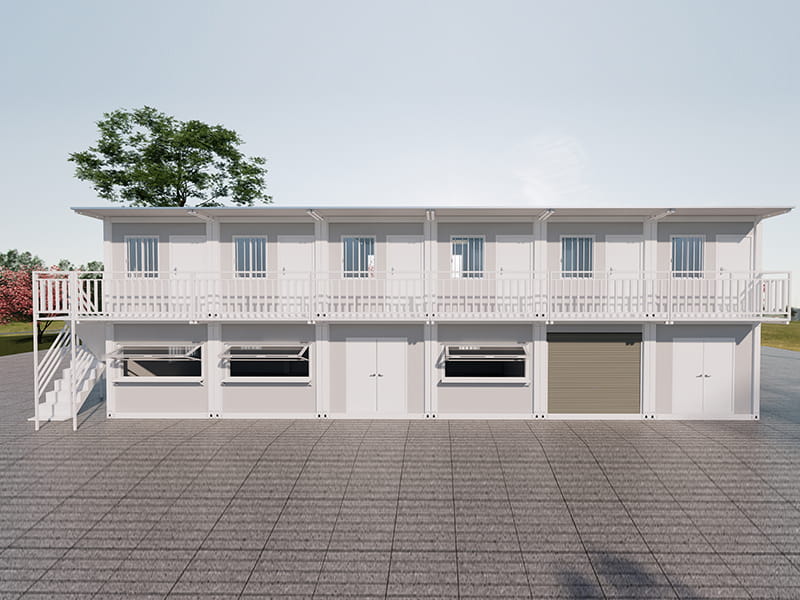
The portable toilet can complement temporary housing, container buildings, mobile offices, and other prefabricated structures. It may be placed as an independent facility or included within a larger temporary site plan developed by the project contractor.
Manufacturing Strengths Behind the Product
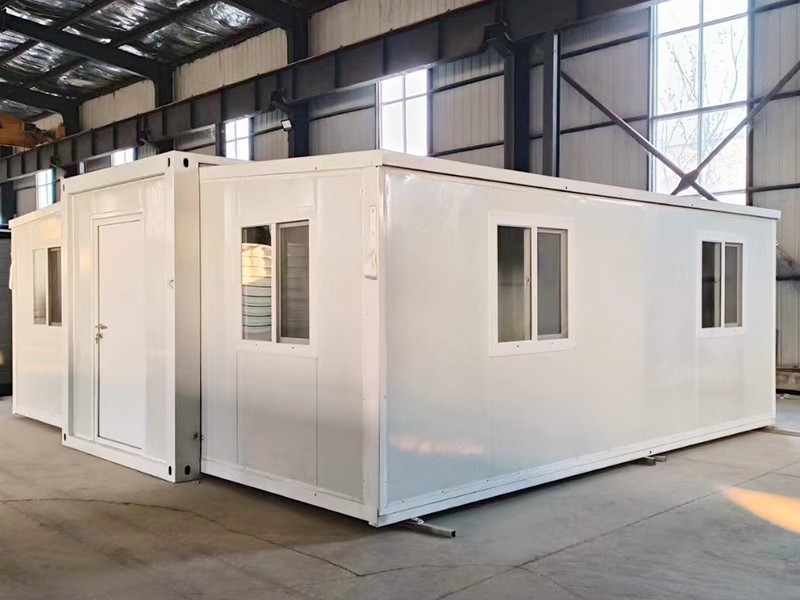
The performance of a portable sanitation unit depends not only on its visible features but also on the manufacturing process used to create it. Suzhou Taimao Integrated Housing Co., Ltd. specializes in integrated housing products and modular building solutions. Its product range includes container houses, folding container houses, double-wing expandable container houses, K-type prefabricated houses, steel structures, portable houses, and outdoor restroom facilities.
This broader manufacturing background is relevant to the Two-Person Outdoor Portable Toilet because portable sanitation units share several production principles with modular buildings. These include structural planning, material coordination, component integration, factory assembly, quality control, packaging, and transportation management.
The company’s stated manufacturing strengths include modular design, proprietary manufacturing technologies, and end-to-end digital software support. These capabilities can help coordinate product development from initial design through production and delivery. For customers, this may improve communication, support customization, and make it easier to align the unit with a specific project requirement.
Factory-Controlled Production
Factory production provides a more controlled environment than unrestricted outdoor construction. Components can be prepared using standardized processes, while assembly teams can work with consistent tools, drawings, and inspection procedures. Weather interruptions are reduced, and the manufacturer can organize materials before the product leaves the facility.
For a portable restroom, factory-controlled production can support better coordination between the structure, compartments, lighting, sink area, doors, internal finishes, and service access points. The result is a more complete unit that requires less field assembly.
Integrated System Thinking
The company’s broader SIP modular building system integrates structure, insulation, mechanical, electrical, and plumbing elements with interior finishes and smart home technologies. Although the Two-Person Outdoor Portable Toilet is a specialized sanitation product rather than a complete residential building, the same integrated approach is valuable.
Instead of treating the walls, lighting, washing station, and interior arrangement as unrelated items, an integrated manufacturer can coordinate them as parts of one finished product. This reduces the risk of mismatched components and makes the unit easier to install and operate.
Digital Design and Project Coordination
Digital software support can assist with design review, component planning, production documentation, and project communication. For standard products, digital workflows help maintain repeatability. For customized orders, they can help translate customer requirements into manufacturing information.
Customers may need variations in color, layout, electrical configuration, branding space, transport arrangements, or supporting facilities. Final feasibility depends on the order scope and technical review, but a digitally supported manufacturer is better positioned to evaluate such requirements systematically.
Modular Manufacturing Experience
Experience in container houses and prefabricated buildings gives the manufacturer an understanding of transport limitations, lifting procedures, structural stability, weather exposure, and rapid installation. These considerations are directly relevant to a portable restroom that may be moved between different sites.
Modular experience also supports scalability. A customer requiring one unit for a small construction site may have different needs from an international contractor requiring multiple sanitation units for several projects. A manufacturer with an established modular production system can potentially support both individual and larger-volume orders, subject to production planning.
Material and Structural Considerations
The product is described as having a robust and stable structure suitable for outdoor conditions and frequent relocation. For long-term performance, the choice and treatment of structural materials are important. Outdoor restroom facilities must balance strength, weight, corrosion resistance, insulation, cleanability, and transportation requirements.
Steel-based structural components are commonly used in portable and prefabricated buildings because they can provide strength and dimensional stability. Proper surface treatment and protective finishing are important where the unit will be exposed to moisture, coastal air, industrial dust, or repeated cleaning.
Wall and ceiling materials should be selected with attention to hygiene and maintenance. Smooth, durable surfaces are generally easier to clean than porous or heavily textured finishes. Floor materials should provide adequate wear resistance and support routine washing while reducing slip risks when properly maintained.
The final material specification may vary according to the customer’s destination, climate, transport method, and local regulations. Buyers should request detailed technical information before placing an order, including structural materials, surface finishes, insulation options, electrical details, plumbing arrangements, and maintenance recommendations.
Hygiene, Cleaning, and Maintenance
A well-designed portable restroom supports hygiene, but regular management is equally important. The unit should be incorporated into a documented cleaning and inspection program. Cleaning frequency depends on the number of users, operating hours, weather conditions, and the type of site.
Routine maintenance may include:
Cleaning and disinfecting toilet compartments and high-contact surfaces.
Inspecting doors, locks, hinges, handles, and ventilation points.
Checking the external sink and associated water or drainage arrangements.
Maintaining lighting fixtures and confirming that illumination remains functional.
Removing waste according to local environmental and sanitation requirements.
Checking the structure for signs of corrosion, damage, water penetration, or instability.
Keeping the surrounding ground clean, level, and free from obstructions.
The external handwashing sink should remain supplied and operational during opening hours. Soap, water, drying materials, and waste containers should be provided according to the site’s hygiene plan. A visible and well-maintained washing station can significantly improve user behavior and overall satisfaction.
Operators should also establish a response procedure for blocked drainage, damaged fixtures, lighting failure, unpleasant odors, or accidental contamination. Fast maintenance protects the condition of the unit and helps preserve public confidence in the facility.
Installation and Site Planning
The portable format simplifies installation, but the site still requires careful preparation. The unit should be placed on firm, stable ground with suitable access for delivery, inspection, cleaning, and eventual relocation. Standing water, unstable soil, steep slopes, and locations exposed to uncontrolled vehicle movement should be avoided unless properly prepared.
Access routes should accommodate the delivery vehicle and any equipment needed for unloading. Operators should consider overhead clearance, turning space, temporary road conditions, and the final distance between the delivery point and the installation position.
The unit should be located where users can reach it safely and easily. At public events, it should be visible but not placed in a way that blocks emergency routes, food-service operations, pedestrian circulation, or vehicle access. At construction sites, it should be close enough to work areas for convenience while remaining outside hazardous zones.
Utility planning is also important. Depending on the project configuration, the sink may require a clean-water source and an appropriate wastewater solution. The lighting system may require electrical connection or a suitable temporary power arrangement. Customers should confirm these details with the manufacturer before delivery to avoid delays during commissioning.
Customization and Project-Specific Requirements
Different customers may require different configurations. An event organizer may request a specific exterior color or identification method. A construction contractor may need several units positioned according to a site plan. An emergency organization may require transport-focused packaging and rapid delivery coordination.
Potential areas for project discussion may include exterior finish, internal layout, electrical supply, lighting arrangement, water and wastewater connections, accessibility considerations, signage, branding placement, climate adaptation, and quantity requirements. Any modification should be reviewed for structural, manufacturing, transportation, and regulatory feasibility.
The manufacturer’s experience with custom construction-site portable houses, temporary housing, mobile homes, and modular buildings provides a foundation for project-based cooperation. Rather than offering only a fixed retail item, the company can evaluate the product as part of a broader temporary infrastructure plan.
Customers should provide accurate information about the destination country, intended use, expected number of users, operating period, climate, transport restrictions, utility availability, and local compliance requirements. Clear information at the beginning of the project helps the manufacturer recommend an appropriate configuration.
Operational Value for Contractors and Facility Managers
For contractors and facility managers, the value of a portable restroom is measured by more than its purchase price. The total operational benefit includes delivery time, installation labor, ease of maintenance, flexibility, service life, relocation capability, and user acceptance.
A pre-assembled dual-compartment unit may reduce the number of separate procurement items. Instead of sourcing partitions, wash stations, lighting, and individual toilet units from different suppliers, the customer can obtain an integrated facility from one manufacturer. This can simplify purchasing, project coordination, and after-sales communication.
Mobility also creates long-term flexibility. A facility that can be reused at multiple locations may provide greater value than a temporary structure designed for only one project. Contractors working across several sites can plan a portable sanitation inventory and move units as project requirements change.
The organized design may also support easier inspection. Separate compartments, an external sink, and integrated lighting give managers identifiable areas to check during routine site visits. A clear inspection process helps maintain cleanliness, operational reliability, and compliance with internal safety procedures.
Environmental and Resource Considerations
Temporary buildings can support more sustainable project planning when they are designed for reuse rather than disposal. A mobile restroom that can be relocated and maintained across multiple projects may reduce the need for repeated construction and demolition.
Factory production can also help control material use. Components can be measured, cut, assembled, and inspected in a controlled environment, potentially reducing on-site waste. Modular manufacturing supports repeatable dimensions and replacement planning, which may make repairs more practical than complete reconstruction.
Environmental performance depends on the complete operating system. Wastewater must be handled responsibly, cleaning chemicals should be selected with care, and damaged components should be repaired or replaced rather than discarded whenever practical. Power consumption, water use, transport distance, and the number of relocations also affect the product’s environmental impact.
The company’s wider mission emphasizes reducing ecological impact through modular construction and factory-based production. For customers seeking temporary infrastructure with a lower construction burden, a reusable portable restroom can form part of a more resource-conscious project strategy.
Quality and Safety Priorities
Quality control for a portable restroom should cover both visible appearance and functional performance. The structure must remain stable, doors should operate properly, lighting should function, and the washing station should be suitable for the intended operating conditions.
Safety considerations include stable placement, safe entry and exit, adequate illumination, appropriate electrical protection, controlled water and wastewater connections, and regular inspection of surfaces and fixtures. The unit should not be placed where flooding, falling materials, vehicle impact, or other foreseeable hazards could occur.
Customers should ask for documentation relevant to their destination and application. Depending on the market, this may include product drawings, material information, electrical specifications, loading details, installation guidance, maintenance instructions, and applicable compliance documents.
Suzhou Taimao Integrated Housing Co., Ltd. positions itself as a manufacturer of globally certified modular building solutions. Specific certificates and approvals can vary by product and destination, so buyers should confirm which documentation applies to the selected portable restroom configuration and intended country of use.
How to Select the Right Portable Restroom Supplier
A supplier should be evaluated according to manufacturing capability, product integration, communication quality, customization support, delivery coordination, and after-sales service. A trading company that simply resells individual units may not provide the same level of technical coordination as an integrated manufacturer.
Important questions for buyers include:
Does the supplier manufacture the structure or only distribute it?
Can the supplier provide product drawings and technical specifications?
Are the lighting and handwashing functions integrated into the product?
Can the unit be adapted to the destination climate and utility conditions?
What are the requirements for loading, transport, unloading, and placement?
What maintenance and spare-parts support is available?
Can the supplier support single-unit and volume orders?
What quality and compliance documentation is provided?
How are customer changes handled before production begins?
A manufacturer with experience in modular housing and prefabricated construction may be able to provide more comprehensive assistance. This is especially useful when the restroom must be coordinated with container houses, worker accommodation, temporary offices, or complete construction-site facilities.
Why Choose an Integrated Modular Manufacturer
An integrated modular manufacturer can connect product design, structural engineering, component production, assembly, inspection, and logistics more effectively than a fragmented supply chain. This can be beneficial when the customer requires more than a standard portable toilet.
Suzhou Taimao Integrated Housing Co., Ltd. combines portable sanitation products with a wider portfolio of integrated housing systems. Its experience includes container homes, expandable container structures, prefabricated houses, steel structures, temporary housing, mobile homes, and modular buildings. This range allows the company to understand how a restroom unit may function within a broader project.
The company’s SIP modular building approach brings structure, insulation, MEP systems, HVAC, interior finishing, and smart technologies into a coordinated factory-produced system. While the Two-Person Outdoor Portable Toilet is a dedicated sanitation product, the same emphasis on integration and factory quality supports its development and production.
For international buyers, an experienced manufacturer can also help coordinate export packaging, product documentation, transportation planning, and destination-specific requirements. The final scope of support should be agreed upon during the quotation and technical review process.
Frequently Asked Questions
What is the Two-Person Outdoor Portable Toilet?
It is a compact mobile restroom facility with separate male and female compartments, built-in lighting, and an external handwashing sink. It is designed for outdoor, temporary, construction, event, camping, and emergency applications.
Does the unit include separate male and female areas?
Yes. The product includes independent male and female compartments to improve privacy, organization, and user convenience.
Is the portable restroom delivered pre-assembled?
The unit is designed as a pre-assembled facility, allowing rapid deployment after delivery. Site-specific utility connections and preparation may still be required before operation.
Can it be used at night?
Yes. The unit includes a built-in lighting system intended to support use at night and in low-light conditions. The required power arrangement should be confirmed for the destination site.
Does it include a handwashing facility?
Yes. An external handwashing sink is included to support hygiene and convenience. Water supply, drainage, soap, and related operating arrangements should be planned according to the project.
Can the unit be relocated?
Yes. Its portable structure is intended to support transport and frequent relocation. Proper loading, lifting, site access, and placement procedures should be followed.
Where can the unit be used?
Typical applications include construction sites, festivals, exhibitions, sports events, campsites, temporary worker accommodation, public projects, outdoor recreation areas, and emergency-relief locations.
Is the unit suitable for permanent use?
The product is primarily designed for portable and temporary sanitation. It may be used for extended periods when properly maintained, but customers should confirm the intended operating period, local regulations, utility requirements, and maintenance plan before purchase.
Can the design be customized?
Project-specific options may be available depending on the required quantity, destination, layout, utilities, exterior finish, signage, and technical conditions. Customers should provide detailed requirements for review before production.
What makes it different from a basic single portable toilet?
The main differences are the two independent male and female compartments, the integrated external handwashing sink, built-in lighting, and coordinated pre-assembled structure. These features provide a more complete facility for organized outdoor use.
How should the product be maintained?
Maintenance includes regular cleaning and disinfection, waste management, inspection of doors and fixtures, checking the sink and lighting, and monitoring the structure for damage or water penetration. Cleaning frequency should reflect the number of users and operating conditions.
What information should be provided when requesting a quotation?
Customers should provide the destination country, quantity, intended application, expected operating period, climate, delivery location, utility availability, customization requirements, and preferred delivery schedule. This information helps the manufacturer prepare a more accurate proposal.
Conclusion
The Two-Person Outdoor Portable Toilet is a practical response to the growing need for fast, flexible, and hygienic sanitation infrastructure. Its separate male and female compartments provide improved privacy and organization, while the external handwashing sink supports better hygiene. Built-in lighting expands its usefulness into nighttime and low-light operations, and the robust portable structure allows it to serve changing project requirements.
Compared with basic single portable toilets, the product offers a more complete and coordinated facility. Compared with permanent restroom construction, it can be deployed faster and relocated more easily. Compared with assembling several unrelated temporary components, it provides a simpler integrated solution for operators responsible for installation, cleaning, inspection, and transport.
Its value is strengthened by the manufacturing capabilities of Suzhou Taimao Integrated Housing Co., Ltd. The company’s experience in modular buildings, container houses, steel structures, temporary housing, and prefabricated systems supports a factory-based approach to structural production and product integration. Its modular design expertise, digital project support, and broader SIP building technology provide a foundation for serving both standard and project-specific requirements.
For construction contractors, event organizers, campsite operators, emergency-response teams, and facility managers, the unit can provide reliable sanitation access without the time and complexity of permanent building construction. With appropriate site preparation, utility planning, cleaning, and maintenance, it can become a reusable part of a modern temporary infrastructure system.
References
1. Suzhou Taimao Integrated Housing Co., Ltd., Product Information for the Two-Person Outdoor Portable Toilet.
2. Suzhou Taimao Integrated Housing Co., Ltd., Company Information on Modular Building Systems and Prefabricated Construction.
3. General principles of portable sanitation planning for construction sites, outdoor events, temporary facilities, and emergency operations.
4. General practices for hygiene management, handwashing facilities, sanitation maintenance, and temporary wastewater handling.
5. General modular construction principles concerning factory assembly, transportation, rapid deployment, and reusable temporary structures.
Product: Two-Person Outdoor Portable Toilet

For exclusive deals and latest offers, sign up by entering your email address below.

-
TEL:+86 18762912902
-
Email:cntaimao@163.com
-
WhatsApp:
-
Add:Group 5, Cao Village, Zhenze Town, Suzhou, Jiangsu, China
Copyright © Suzhou Taimao Integrated Housing Co., Ltd.
All Rights Reserved.
 Wholesale movable homes for sale
custom built modular homes