

 EN
EN
 русский
 Español
 عربى
عربى Français
Two-Person Outdoor Portable Toilet: A Practical, Hygienic, and Rapid-Deployment Sanitation Solution
Admin 2026-08-16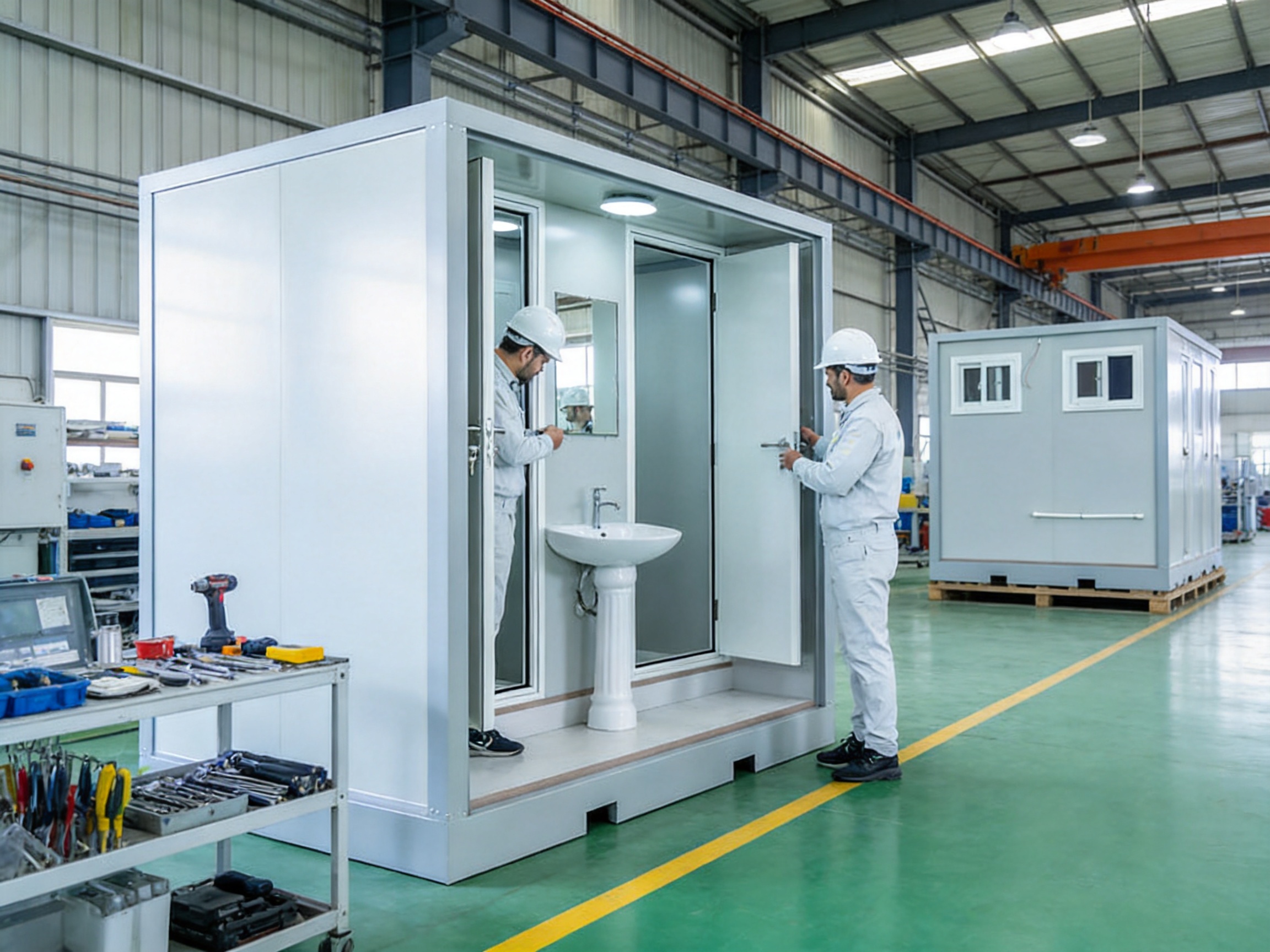
Access to clean, private, and reliable sanitation is essential wherever people gather, work, travel, or respond to emergencies. Outdoor events, construction sites, temporary camps, disaster-relief operations, agricultural locations, and remote work areas often require restroom facilities that can be installed quickly without the cost and complexity of permanent construction. The Two-Person Outdoor Portable Toilet is designed to meet this need with a compact, durable, and ready-to-use mobile sanitation system.
Unlike ordinary single-cubicle portable toilets, temporary indoor rooms, or converted shipping containers, this unit is designed specifically for efficient outdoor restroom service. It combines separate male and female compartments, built-in lighting, an external handwashing sink, and a robust structure in one coordinated product. The result is a practical facility that can be transported, positioned, and put into service with minimal preparation.
The product is manufactured and supplied by Suzhou Taimao Integrated Housing Co., Ltd., a company specializing in integrated housing, prefabricated buildings, portable facilities, modular construction, and steel structure solutions. Although the company is widely associated with container houses, modular homes, and construction-site buildings, its manufacturing capabilities also support specialized products such as portable sanitation units.
This article examines the design, advantages, manufacturing approach, application value, maintenance requirements, and purchasing considerations of the Two-Person Outdoor Portable Toilet. It also explains why an integrated factory-made unit can provide meaningful advantages over improvised site-built restrooms and lower-quality portable alternatives.
Content
- 1 1. Product Overview
- 2 2. Why Portable Sanitation Requires Purpose-Built Design
- 3 3. Main Product Features
- 4 4. Advantages Over Common Portable Restroom Alternatives
- 5 5. Applications in Different Operating Environments
- 6 6. Manufacturing Strengths Behind the Product
- 7 7. Quality, Safety, and Operational Reliability
- 8 8. Installation and Deployment Process
- 9 9. Maintenance and Lifecycle Management
- 10 10. Environmental and Sustainability Considerations
- 11 11. Purchasing Considerations for International Buyers
- 12 12. Why Work with an Integrated Manufacturer
- 13 13. Recommended User Groups
- 14 14. Practical Limitations and Proper Expectations
- 15 15. Frequently Asked Questions
- 15.1 15.1 How many restroom compartments does the unit include?
- 15.2 15.2 Is the portable toilet delivered ready for immediate use?
- 15.3 15.3 Does it include lighting?
- 15.4 15.4 Is a handwashing sink included?
- 15.5 15.5 Can the unit be moved after installation?
- 15.6 15.6 Where can this product be used?
- 15.7 15.7 Is it suitable for year-round outdoor use?
- 15.8 15.8 Can the design be customized?
- 15.9 15.9 What should be prepared at the installation site?
- 15.10 15.10 How does it compare with a basic portable toilet?
- 15.11 15.11 Who manufactures the product?
- 15.12 15.12 What information should be included in an inquiry?
- 16 16. Conclusion
- 17 References
- 18 Product: Two-Person Outdoor Portable Toilet
1. Product Overview
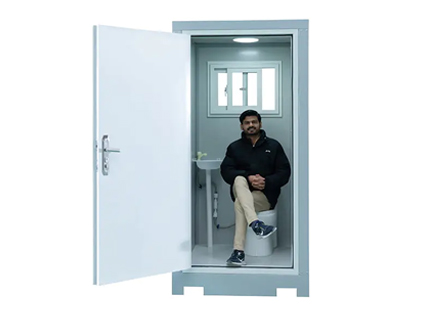
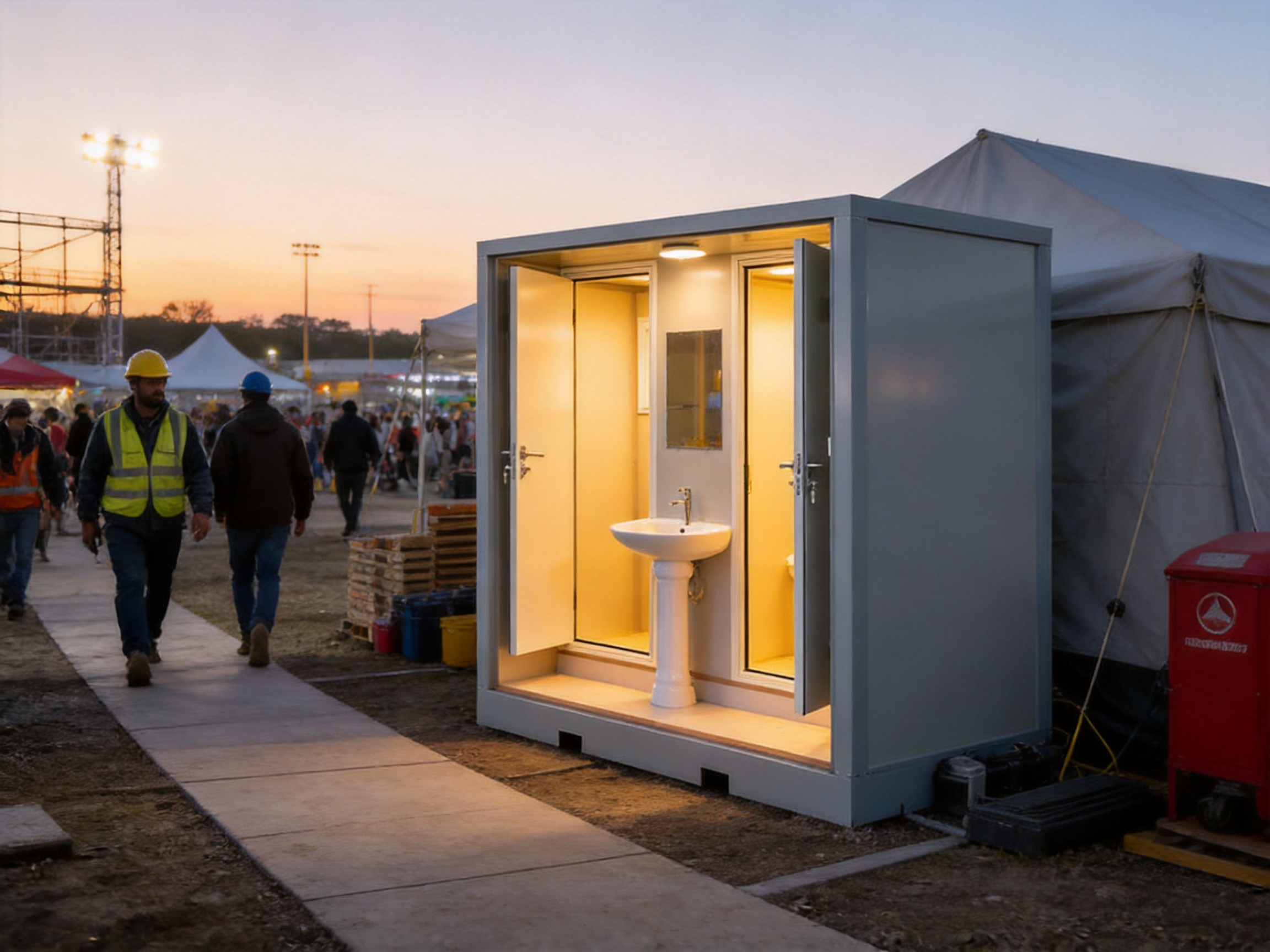
The Two-Person Outdoor Portable Toilet is a mobile restroom facility intended for locations where conventional permanent toilets are unavailable, impractical, or too slow to build. Its compact format makes it suitable for temporary deployment while its independent compartments help improve privacy and user organization.
The basic configuration includes separate male and female restroom compartments. This arrangement allows users to enter a designated space without relying on a shared interior. It is particularly useful at public events, work areas, temporary accommodation sites, and locations where user comfort and privacy are important.
The unit also includes a built-in lighting system. Lighting is a valuable feature for outdoor sanitation because these facilities are frequently used in the evening, at night, or in areas where electrical infrastructure is incomplete. Integrated illumination improves visibility inside the restroom and helps users move more safely around the facility.
An external handwashing sink is included to support hygiene before users return to an event area, work zone, dining area, or living space. By placing the handwashing station outside the restroom compartments, the layout encourages a clear separation between toilet use and handwashing. It can also make the facility easier to manage during busy periods.
The structure is designed to be stable, durable, and suitable for outdoor conditions. Its construction supports frequent relocation, which is an important requirement for event organizers, contractors, emergency agencies, and rental-service providers. The unit is not limited to one permanent site; it can be moved as project phases, site layouts, or operational needs change.
Because the product is pre-assembled for rapid deployment, users do not need to undertake extensive on-site construction before the restroom becomes operational. This reduces preparation time and can lower the need for specialized labor. In temporary projects, speed is often as important as purchase price because delays can affect the entire schedule.
2. Why Portable Sanitation Requires Purpose-Built Design
Portable sanitation is sometimes treated as a basic shelter problem, but a successful restroom facility must address much more than enclosure. It needs to provide privacy, safe access, hygiene support, weather resistance, ease of cleaning, structural stability, and practical logistics. A product that solves only one of these issues may create additional problems during daily use.
A makeshift toilet built from common panels or temporary partitions may appear inexpensive at first. However, such a structure may not provide adequate separation between users, sufficient ventilation, appropriate lighting, or a stable floor. It may also require repeated repairs when exposed to rain, wind, dust, and frequent relocation.
Traditional permanent restroom construction can deliver a high level of comfort, but it usually requires foundations, utility connections, drainage work, masonry or steel framing, interior finishing, and a longer construction schedule. These requirements are not always suitable for a short-term site or remote location.
Basic single-cubicle portable toilets can be useful for small gatherings, but they may not provide enough capacity or privacy for larger groups. They may also lack a dedicated handwashing station or integrated lighting. A two-compartment product offers a more organized solution while maintaining the flexibility of a mobile unit.
The Two-Person Outdoor Portable Toilet addresses these practical requirements through an integrated design. Instead of treating the restroom, lighting, hygiene station, and enclosure as separate items, the product combines them into a coordinated facility intended for immediate deployment and repeated use.
3. Main Product Features
3.1 Separate Male and Female Compartments
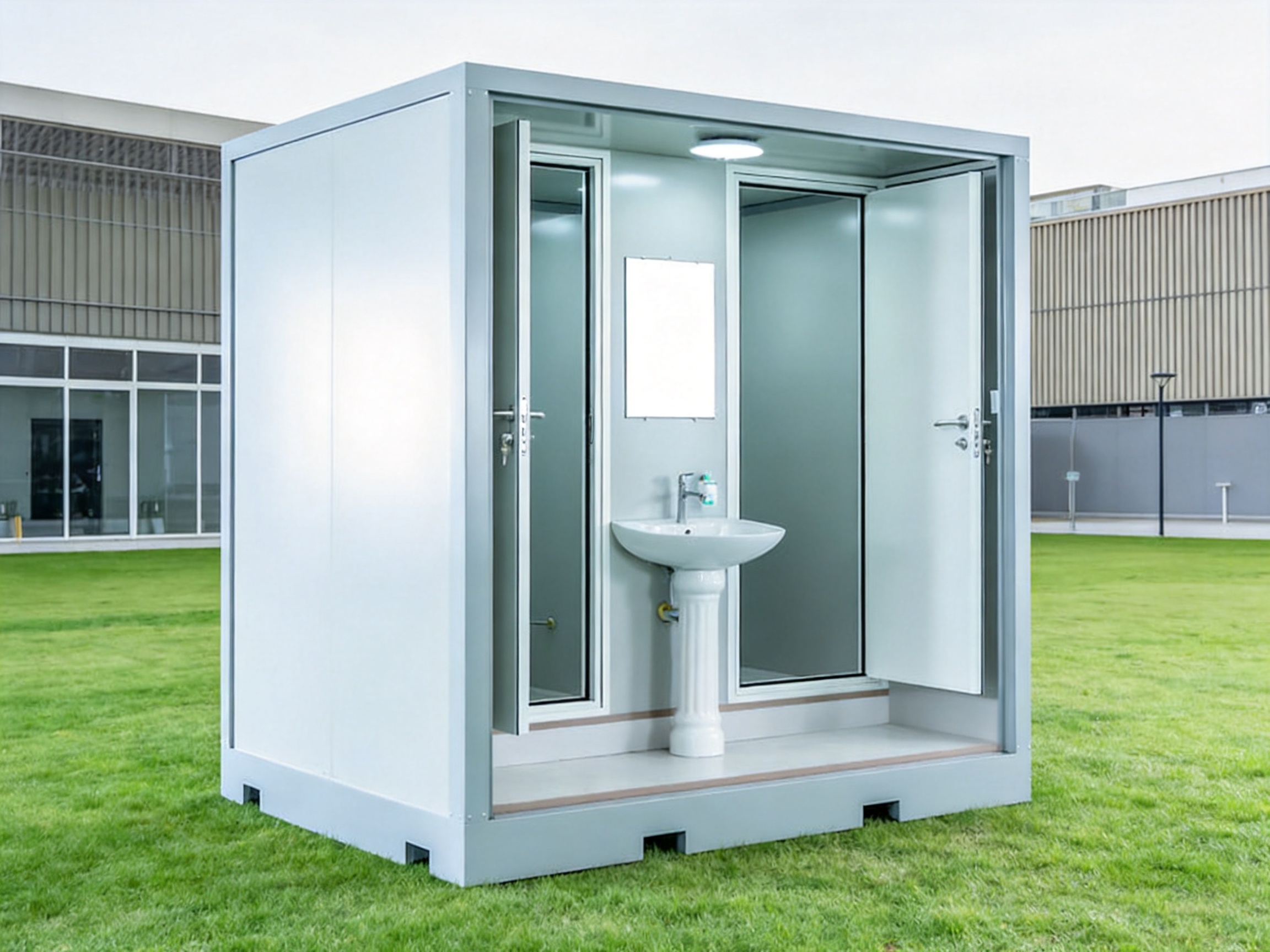
The dual-compartment layout is one of the product’s most important advantages. Independent male and female restrooms create a more comfortable user experience and provide a clear arrangement for public or workplace use. This is especially valuable at events where many people may need access within a short period.
Separate compartments also help facility managers control traffic more effectively. Users can identify the appropriate space quickly, reducing confusion and unnecessary queues. At construction sites or temporary accommodation areas, the arrangement can support more orderly daily operation.
The dual design is also more adaptable than a single shared compartment. It can be positioned at festivals, outdoor exhibitions, sports events, work camps, roadside service areas, temporary markets, and emergency response sites. The same basic unit can serve different industries without requiring a major change in layout.
3.2 Built-In Lighting
Lighting is essential for a restroom that may be used after sunset or in poorly illuminated environments. The built-in lighting system helps users see the interior, identify fixtures, and enter or leave the compartments with greater confidence.
Integrated lighting is generally more convenient than relying on temporary lamps placed inside the facility after delivery. A separate lamp may be forgotten, damaged, poorly positioned, or difficult to power. A factory-integrated lighting arrangement is part of the overall product design and can contribute to a cleaner, more organized interior.
For event organizers and construction managers, lighting also reduces the amount of additional equipment that must be sourced and installed. This supports faster preparation and simplifies site management. The precise power arrangement should be confirmed according to the project, location, and local electrical requirements before purchase.
3.3 External Handwashing Sink
Handwashing is a basic but critical part of sanitation. The external sink gives users a convenient location to clean their hands after using the restroom. It can also help reduce the spread of dirt and contamination in areas where people eat, work, sleep, or gather.
Placing the sink outside the main restroom compartments helps make it visible and accessible. At busy events, users may be able to wash their hands without creating congestion inside the facility. The external arrangement can also simplify refilling, cleaning, and routine inspection by site personnel.
The handwashing station is particularly valuable in construction environments, outdoor food-service areas, temporary camps, and emergency-relief operations. In these situations, hygiene infrastructure must be easy to understand and simple to maintain. A clearly visible external sink supports both user convenience and better sanitation habits.
3.4 Robust and Stable Structure
Outdoor facilities are exposed to changing weather, repeated use, dust, moisture, transportation vibration, and frequent handling. The portable restroom therefore needs a structure that is more substantial than a temporary fabric enclosure or lightweight partition system.
The product is designed with a robust and stable structure suitable for outdoor use. This supports a more secure user experience and helps the unit remain functional after relocation. A stable structure is also important for doors, partitions, lighting, plumbing components, and other integrated features because these elements perform better when the overall enclosure remains properly aligned.
Durability is not limited to surviving one event. A well-designed portable restroom should be capable of repeated deployment, cleaning, transport, and repositioning. This makes it more suitable for rental fleets, construction contractors, event companies, and organizations that need temporary sanitation at multiple locations.
3.5 Pre-Assembled Delivery
The unit is supplied in a pre-assembled or substantially prepared condition, enabling rapid installation and use after delivery. This approach minimizes the amount of on-site construction needed and helps users avoid the delays associated with building a restroom from individual materials.
Pre-assembly also improves consistency. Components can be fitted and checked in a controlled factory environment rather than being assembled under uncertain site conditions. This is particularly beneficial when the destination has limited tools, limited labor, poor weather, or restricted access to technical workers.
For emergency applications, rapid deployment can be decisive. A portable restroom that arrives ready for use can support affected communities, rescue workers, temporary medical areas, and relief teams more quickly than a facility that requires extensive site work.
Two-Person Outdoor Portable Toilet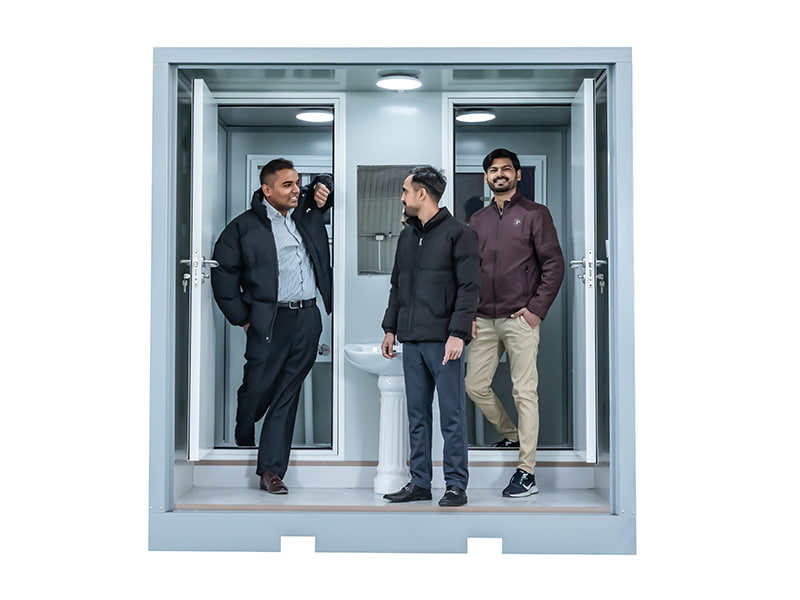
4. Advantages Over Common Portable Restroom Alternatives
Portable sanitation products vary considerably in quality and purpose. The Two-Person Outdoor Portable Toilet is positioned as a practical middle ground between basic single-use portable toilets and permanent modular restroom buildings. Its value comes from combining useful features without sacrificing mobility.
| Comparison Factor | Two-Person Outdoor Portable Toilet | Basic Single-Cubicle Unit | Site-Built Temporary Restroom | Permanent Restroom Building |
|---|---|---|---|---|
| Deployment speed | Rapid deployment with limited on-site work | Very rapid | Usually requires construction | Longer construction period |
| Compartment arrangement | Separate male and female compartments | Usually one shared-use compartment | Depends on site design | Can be fully customized |
| Mobility | Designed for relocation | Highly mobile | Limited after installation | Generally permanent |
| Lighting | Built-in lighting system | May require separate equipment | Must be installed on site | Integrated through permanent utilities |
| Handwashing | External handwashing sink included | May be absent or separate | Requires additional planning | Usually integrated into building services |
| Best use | Events, construction, camps, and emergencies | Small-scale temporary use | Longer temporary projects | Long-term or permanent facilities |
Compared with a basic single-cubicle product, the two-person configuration provides better organization and greater functional capacity. Separate compartments can improve privacy and reduce the perception that the facility is merely a minimal emergency option.
Compared with a site-built temporary restroom, the factory-made unit reduces the number of decisions that must be made at the project location. The structure, compartments, lighting, and handwashing feature are planned as one product. This can lower installation complexity and reduce the risk of inconsistent workmanship.
Compared with a permanent restroom building, the portable unit offers a much shorter deployment cycle and greater flexibility. It can serve a temporary site without creating a long-term building commitment. When a construction project ends or an event location changes, the facility can be relocated rather than demolished or abandoned.
The product is not intended to replace every permanent restroom. Large campuses, hotels, schools, and long-term public buildings may require larger systems with extensive plumbing, accessibility arrangements, wastewater treatment, and customized interior finishes. However, for temporary and mobile applications, the portable unit can provide a more proportionate and efficient solution.
5. Applications in Different Operating Environments
5.1 Outdoor Events
Concerts, festivals, fairs, exhibitions, sports gatherings, weddings, and community events frequently need temporary restrooms. Event organizers must provide sanitation without permanently changing the venue. The Two-Person Outdoor Portable Toilet can be positioned near activity zones, parking areas, temporary dining spaces, or backstage service areas.
The separate compartments help organize public use, while the external sink supports hygiene around food and gathering areas. Built-in lighting extends the practical operating period into the evening. The mobile format also allows organizers to adjust the site layout according to crowd movement and event scheduling.
For event companies, repeat usability is an important economic consideration. A robust unit can potentially be deployed at multiple events, provided that cleaning, inspection, sanitation, and local regulatory requirements are properly managed between uses.
5.2 Construction Sites
Construction workers may spend months or years at locations without permanent restroom facilities. Building a permanent toilet at the beginning of a project may be too expensive or too slow, particularly when the site layout changes during different construction phases.
A portable restroom can be placed near worker access points, material storage zones, temporary offices, or accommodation areas. As the project progresses, it can be moved to maintain reasonable access. This flexibility is useful for residential developments, infrastructure works, industrial construction, road projects, and remote engineering sites.
The robust structure is important in construction environments where dust, equipment movement, vibration, and heavy daily use are common. The external handwashing sink can also support better hygiene for workers before meals or after completing dirty tasks.
5.3 Camping and Outdoor Recreation
Camping areas and outdoor recreation sites may be located far from municipal sewage systems. A portable restroom can provide a more organized facility than informal or improvised arrangements. The compact design is suitable for temporary camps, seasonal recreation areas, outdoor training programs, and remote tourism facilities.
Lighting improves convenience for evening use, while separate compartments provide greater privacy for groups. The unit can be installed for a season and relocated or stored when the site is closed, helping operators match facilities to changing visitor numbers.
5.4 Emergency and Disaster Relief
Natural disasters, severe weather events, infrastructure failures, and humanitarian emergencies can interrupt access to normal sanitation. In these circumstances, portable restrooms are an important part of the basic response system.
The ability to deploy the unit rapidly is especially valuable when communities are using temporary shelters, field hospitals, distribution centers, or emergency camps. Separate compartments can support more orderly use, while the external sink contributes to hygiene control.
Emergency agencies should evaluate site drainage, waste management, water supply, accessibility, local health requirements, and the number of users before deployment. The restroom is a sanitation component within a wider emergency plan, not a substitute for complete wastewater and public-health management.
5.5 Temporary Worker Accommodation
Temporary labor camps, agricultural sites, mining areas, and remote project offices may require additional sanitation capacity for workers. A portable toilet can supplement existing facilities or provide service while permanent buildings are being installed.
Its mobility is useful when work teams move between locations. Instead of constructing a restroom at every temporary work area, an organization may relocate the unit as needed, reducing duplication of infrastructure and supporting better resource utilization.
6. Manufacturing Strengths Behind the Product
The quality of a portable restroom depends heavily on the manufacturing system used to produce it. A product may appear simple from the outside, but its performance depends on accurate structural assembly, reliable component integration, proper finishing, and consistent inspection.
Suzhou Taimao Integrated Housing Co., Ltd. operates as an integrated housing and modular building manufacturer. Its capabilities include modular design, prefabricated construction, steel structure production, portable buildings, container houses, temporary housing, and related integrated facilities. This background is relevant to portable sanitation because the product requires many of the same capabilities used in modular construction.
The company’s manufacturing philosophy emphasizes moving a substantial portion of construction and finishing work into a controlled factory environment. Factory production can provide a more repeatable workflow than completely site-built construction. Materials can be organized in advance, production steps can be standardized, and quality checks can occur before shipment.
6.1 Integrated Design and Engineering
Integrated design means that structural elements, partitions, lighting, handwashing components, doors, surfaces, and transport considerations are evaluated as one system. This is preferable to adding separate products together after delivery, because compatibility problems can be identified earlier.
The company’s broader modular-building experience supports design coordination between structure, insulation, mechanical systems, electrical elements, and interior finishes. Although the portable toilet is smaller and more specialized than a modular house, the same principle of coordinated design helps improve reliability and installation efficiency.
For buyers with special requirements, the manufacturer’s experience in custom portable buildings may also support project-specific discussions regarding layout, appearance, transport, site conditions, and intended use. Any customization should be confirmed through technical drawings and a formal quotation before production.
6.2 Factory-Controlled Prefabrication
Prefabrication allows components to be prepared and assembled before they reach the final site. This reduces exposure to rain, wind, mud, and other conditions that can affect field construction. It also allows production personnel to work with appropriate tools and equipment in a dedicated facility.
Factory-controlled assembly can improve dimensional consistency and reduce the likelihood of gaps, misaligned components, or incomplete finishing. It also makes it easier to establish standard inspection points. These may include checking structural connections, doors, lighting, sink installation, surface condition, and general stability.
Another advantage is reduced site disruption. Construction areas and event venues often have limited working space. A pre-assembled product can arrive with much of the work already completed, leaving the site team to focus on positioning, connections, utility preparation, and commissioning.
6.3 Steel Structure Expertise
Steel structure is an important part of the company’s broader product portfolio. Steel can provide a strong framework for portable facilities while supporting efficient prefabrication. In a mobile restroom, a stable structural frame helps protect internal components during repeated handling and relocation.
The exact steel grade, surface treatment, coating system, and connection method should be confirmed for each order. Buyers operating in coastal, humid, dusty, or chemically aggressive environments should communicate local conditions so that suitable corrosion-protection measures can be evaluated.
Structural performance also depends on correct site placement. Even a well-manufactured facility should be positioned on a suitable base and secured according to the manufacturer’s instructions and local wind or safety requirements.
6.4 SIP and Modular Building Knowledge
The company’s flagship SIP modular building system integrates structural insulated panels with insulation, MEP services, HVAC, interior finishes, and smart-home technologies. The portable toilet does not need every feature of a complete SIP building, but this experience demonstrates the company’s ability to coordinate multiple building functions within prefabricated products.
Such knowledge is valuable when developing compact facilities where space is limited and every component must be arranged efficiently. A small restroom requires careful planning because lighting, doors, partitions, sinks, ventilation, structural elements, and service access must coexist within a restricted footprint.
Modular expertise can also support future product development. Different customers may require portable shower rooms, worker welfare units, site offices, accommodation modules, or combined sanitation blocks. A manufacturer with an integrated housing background can evaluate these products as part of a broader temporary-building system.
6.5 Digital Support and Production Coordination
The company describes its capabilities as including end-to-end digital software support. Digital coordination can help manage design information, production planning, component documentation, and communication between factory and project teams.
For international buyers, clear documentation is particularly important. Drawings, packing information, installation instructions, electrical requirements, and maintenance guidance help reduce misunderstandings between the manufacturer, logistics provider, installer, and end user.
Digital production coordination can also support repeat orders. Event companies, contractors, and distributors may need several units with consistent specifications. Maintaining organized product information helps improve repeatability across different production batches.
7. Quality, Safety, and Operational Reliability
A portable restroom should be evaluated as an operational facility rather than only as a physical box. Reliability includes structural stability, safe entry and exit, functioning lighting, usable handwashing facilities, cleanable surfaces, and practical service access.
Before delivery, buyers should request confirmation of the product’s construction materials, overall dimensions, weight, utility requirements, drainage arrangement, and recommended installation conditions. These details affect transportation, lifting, placement, and daily operation.
Lighting systems should be reviewed for their power source, switching method, protection from moisture, and compatibility with the destination country’s electrical standards. If the unit will be used at night or in wet environments, electrical safety should receive particular attention.
The sink system should be planned with an appropriate water supply and wastewater arrangement. Depending on the location, this may involve a fresh-water tank, a connection to a temporary water line, a graywater collection tank, or another approved arrangement. Local public-health and environmental regulations must be followed.
Ventilation is another practical consideration. Users should confirm how air circulation is achieved and whether additional ventilation is required for the intended climate. A facility that is easy to clean and adequately ventilated will generally provide a more comfortable user experience.
Accessibility requirements should also be reviewed. The standard Two-Person Outdoor Portable Toilet is described as having separate male and female compartments, but project owners should determine whether an additional accessible restroom, ramp, handrail, turning space, or other adaptation is required by local law or site policy.
8. Installation and Deployment Process
Although the unit is designed for quick deployment, successful operation still requires orderly preparation. The first step is selecting a suitable location. The ground should be stable, reasonably level, and accessible for delivery and service vehicles.
The site should not be positioned where heavy rain can cause flooding or where surface water can enter the facility. Drainage, waste collection, user circulation, emergency access, and distance from food-service areas should all be considered.
After delivery, the unit should be inspected for transport damage. Doors, locks, lighting, fixtures, sink components, structural surfaces, and visible connections should be checked before the facility is opened to the public.
The unit should then be positioned and secured according to the manufacturer’s recommendations. In areas exposed to strong wind, additional anchoring or stabilizing measures may be necessary. The correct method depends on the local ground condition, weather exposure, and applicable safety rules.
Water, wastewater, and electrical services should be connected by qualified personnel when required. The lighting system should be tested, and the sink should be checked for proper water flow and drainage. Any leaks, loose fittings, or electrical irregularities should be corrected before use.
A final cleaning and sanitation procedure should be completed before commissioning. Operators should place clear user instructions where appropriate, establish a cleaning schedule, and assign responsibility for inspection and replenishment.
| Deployment Stage | Recommended Action |
|---|---|
| Site selection | Choose stable, level ground with access for delivery and maintenance. |
| Delivery inspection | Check the structure, doors, lighting, sink, surfaces, and visible components. |
| Positioning | Place the unit securely and evaluate the need for anchoring. |
| Utility connection | Connect water, wastewater, and electrical services according to approved requirements. |
| Functional testing | Test lighting, doors, sink operation, drainage, and general stability. |
| Sanitation preparation | Clean and disinfect all user-contact surfaces before opening. |
| Routine management | Establish inspection, cleaning, waste removal, and repair procedures. |
9. Maintenance and Lifecycle Management
Regular maintenance is essential for preserving the product’s appearance, hygiene, and service life. A portable restroom may be used by many people in a short period, so cleaning frequency should be based on actual traffic rather than a fixed assumption.
Interior surfaces should be cleaned with products compatible with the supplied materials. Harsh chemicals should not be used unless approved, because they may damage coatings, seals, fixtures, or fittings. High-touch areas such as door handles, locks, sink surfaces, and switches deserve frequent attention.
The external handwashing sink should be checked for water supply, drainage, cleanliness, and leakage. Where tanks are used, they should be refilled and emptied according to a controlled schedule. Standing water and untreated wastewater should not be allowed to create health or environmental risks.
Lighting should be inspected regularly, especially before evening events. Operators should check lamps, switches, wiring protection, and power connections. Any electrical fault should be addressed by qualified personnel rather than temporarily bypassed.
Doors and hinges should be inspected for alignment and smooth operation. Locks should function correctly, and damaged hardware should be repaired promptly. A door that does not close securely can reduce privacy and create safety concerns.
The exterior should be washed periodically to remove dust, mud, and other contaminants. In coastal or humid environments, exposed metal surfaces should be monitored for corrosion. Early treatment is generally easier and less expensive than repairing extensive damage.
For units that are moved regularly, a relocation checklist is recommended. Before transport, the facility should be emptied, cleaned, disconnected from utilities, and secured. Removable items should be protected, and lifting or handling should follow the specified method.
10. Environmental and Sustainability Considerations
Temporary facilities can support more sustainable construction when they reduce the need for repeated site-built structures. A mobile restroom can be used at multiple locations, extending the value of the materials and reducing demolition waste at the end of a project.
Factory prefabrication may also improve material control. Components can be prepared according to planned dimensions, reducing the uncontrolled waste that sometimes occurs during on-site cutting and fitting. More efficient production does not eliminate waste, but it can make material use easier to monitor.
The product’s environmental performance also depends on operation. Responsible wastewater handling, proper cleaning chemicals, efficient lighting, and regular maintenance all contribute to a better lifecycle result. Buyers should consider not only the initial purchase but also transport distance, service frequency, water use, and end-of-life handling.
For larger projects, the portable restroom can form part of a broader modular site strategy. Temporary offices, accommodation units, dining facilities, storage rooms, and sanitation blocks can be planned as coordinated modules. This can help projects adapt facilities as workforce numbers and site layouts change.
11. Purchasing Considerations for International Buyers
Before placing an order, buyers should provide the manufacturer with complete information about the intended use. Important details include the number of users, deployment period, climate, transport method, available utilities, local regulations, required quantity, and expected frequency of relocation.
Buyers should clarify whether the product will be delivered fully assembled, partially assembled, or packed in a particular transport configuration. The shipping dimensions and weight can affect container loading, inland transport, lifting equipment, and site access.
Electrical specifications should be matched to the destination market. Voltage, frequency, plug type, protection requirements, and installation practice may differ between countries. The manufacturer and local electrical professionals should confirm the correct arrangement before commissioning.
Water and wastewater requirements should be discussed in advance. A portable restroom may be used with tanks or temporary connections depending on the application. The buyer should ensure that the selected configuration is compatible with local sanitation rules and the available service infrastructure.
Documentation is also important. Buyers may request product drawings, material information, installation instructions, maintenance recommendations, packing lists, and quality-control records relevant to the order. Clear documents can help distributors and end users manage the product more effectively.
For projects requiring branding, color changes, additional fixtures, accessibility modifications, or different internal arrangements, customization should be assessed before production begins. Changes made late in the process may affect price, lead time, transport, and certification requirements.
12. Why Work with an Integrated Manufacturer
An integrated manufacturer can offer advantages beyond the supply of one portable restroom. Because Suzhou Taimao Integrated Housing Co., Ltd. works across container houses, modular buildings, temporary housing, portable houses, and steel structures, it can potentially support wider site-infrastructure requirements.
This is useful for contractors and project owners who need multiple types of temporary facilities from one source. A construction project may require portable toilets, site offices, worker accommodation, storage units, security rooms, and welfare facilities. Coordinating these products through an experienced modular-building supplier can simplify communication.
Integrated manufacturing may also improve design consistency. When buildings and sanitation facilities are planned together, buyers can consider circulation, utility routing, appearance, transportation, and site layout at an earlier stage.
The company’s focus on factory manufacturing and digital support can help connect design, production, delivery, and assembly. This end-to-end approach is especially valuable for overseas customers who need a clear process from initial inquiry through final deployment.
Its stated mission includes accelerating project timelines, improving operational efficiency, reducing ecological impact, and maintaining quality and safety. These objectives are relevant to portable sanitation because the product’s main value lies in efficient delivery, reliable use, and reduced dependence on lengthy site construction.
13. Recommended User Groups
The product is suitable for event organizers seeking organized restroom capacity without permanent construction. It can support public festivals, outdoor exhibitions, sports activities, wedding venues, temporary markets, and entertainment programs.
Construction companies can use the unit to provide worker sanitation during different project phases. Its mobility allows it to follow the changing work area, while the sink and lighting features support daily convenience.
Campground operators, outdoor tourism businesses, and seasonal recreation facilities can use the unit where visitor numbers change throughout the year. It can be deployed during high season and stored or relocated when demand declines.
Emergency-relief organizations may benefit from the product’s rapid-deployment characteristics. Units can be incorporated into temporary shelters, field operations, aid distribution points, and recovery projects, subject to local sanitation and logistics planning.
Rental companies can consider the product for a reusable fleet. A standardized two-compartment configuration may be easier to market to different customers than highly specialized facilities, provided that the company maintains strong cleaning, inspection, and transport procedures.
14. Practical Limitations and Proper Expectations
A responsible product evaluation should include limitations as well as advantages. The Two-Person Outdoor Portable Toilet is a temporary and mobile sanitation solution. It is not automatically a replacement for a large permanent restroom building, a complete sewage-treatment system, or a fully accessible public facility unless the required adaptations are included.
Its operating capacity depends on user volume, cleaning frequency, water availability, waste-management arrangements, and local climate. A single unit may be appropriate for one site but insufficient for a large event. Buyers should calculate expected demand and determine whether multiple units are needed.
The product also requires appropriate site management. Even a durable facility can perform poorly if it is placed on unstable ground, connected incorrectly, cleaned infrequently, or exposed to conditions beyond its design assumptions.
These considerations do not reduce the product’s value. Instead, they emphasize the importance of matching the unit to the application. When correctly specified and managed, it can provide a practical balance of mobility, privacy, hygiene, and deployment speed.
15. Frequently Asked Questions
15.1 How many restroom compartments does the unit include?
The standard product includes separate male and female compartments. This dual arrangement supports privacy and more organized use in public, workplace, camping, and emergency environments.
15.2 Is the portable toilet delivered ready for immediate use?
The unit is pre-assembled for rapid deployment. After delivery, it still requires proper positioning, utility connections where applicable, functional testing, cleaning, and compliance checks before opening to users.
15.3 Does it include lighting?
Yes. The product includes a built-in lighting system intended to support use at night or in low-light conditions. Buyers should confirm the exact electrical specifications and power arrangement for their destination.
15.4 Is a handwashing sink included?
Yes. An external handwashing sink is included to support hygiene and user convenience. The required water-supply and wastewater arrangement should be discussed according to the project site.
15.5 Can the unit be moved after installation?
Yes. The product is designed to be portable and suitable for relocation. Before moving it, operators should disconnect utilities, remove or secure contents, clean the unit, and use an appropriate transport or lifting method.
15.6 Where can this product be used?
Typical applications include outdoor events, construction sites, camping areas, temporary work camps, emergency-relief locations, disaster-response projects, agricultural operations, and other sites requiring mobile sanitation.
15.7 Is it suitable for year-round outdoor use?
The structure is designed for outdoor conditions, but suitability depends on the local climate, installation method, maintenance program, and utility configuration. Buyers in areas with extreme heat, freezing temperatures, heavy rain, strong wind, or coastal exposure should discuss conditions with the manufacturer.
15.8 Can the design be customized?
Customization may be possible depending on the project. Potential discussions may include color, layout, additional equipment, accessibility features, utility arrangements, and branding. Custom requirements should be confirmed before production.
15.9 What should be prepared at the installation site?
The site should provide stable and reasonably level ground, delivery access, appropriate drainage, and space for servicing. Depending on the configuration, the site may also need water, wastewater, and electrical connections.
15.10 How does it compare with a basic portable toilet?
The Two-Person Outdoor Portable Toilet offers separate male and female compartments, built-in lighting, and an external handwashing sink in addition to mobility. These features make it more suitable for organized events, construction sites, and group use than a basic single-cubicle unit.
15.11 Who manufactures the product?
The product is supplied by Suzhou Taimao Integrated Housing Co., Ltd., a Chinese manufacturer of modular buildings, container houses, portable houses, temporary housing, prefabricated facilities, and steel structure products.
15.12 What information should be included in an inquiry?
Customers should provide the intended application, quantity, destination, climate, expected user volume, required delivery date, utility conditions, transport limitations, and any customization or compliance requirements. This information helps the manufacturer recommend an appropriate configuration.
16. Conclusion
The Two-Person Outdoor Portable Toilet is designed to provide a practical answer to temporary sanitation requirements. Its separate male and female compartments, built-in lighting, external handwashing sink, durable structure, and rapid-deployment format distinguish it from simpler portable toilet products.
Its main advantage is the balance between mobility and functionality. The unit can be transported and relocated like a temporary facility while offering a more organized and comfortable experience than a basic single-cubicle solution. This makes it suitable for events, construction projects, camping areas, emergency operations, and temporary work locations.
The product also benefits from the manufacturer’s broader experience in integrated housing and modular construction. Factory-controlled prefabrication, steel structure knowledge, coordinated design, digital production support, and experience with modular building systems provide a strong foundation for producing reliable portable facilities.
For buyers, the most important step is to match the unit to the actual project. Site conditions, user volume, wastewater management, electrical requirements, accessibility, climate, transport, and maintenance should all be reviewed before ordering. With proper planning and responsible operation, the Two-Person Outdoor Portable Toilet can become a reusable, efficient, and hygienic component of a modern temporary-site infrastructure system.
References
1. Product information supplied for the Two-Person Outdoor Portable Toilet, including its compartments, lighting system, handwashing sink, portability, and outdoor-use characteristics.
2. Company profile information supplied for Suzhou Taimao Integrated Housing Co., Ltd., including modular building, prefabrication, steel structure, SIP systems, and digital manufacturing support.
3. General principles of temporary sanitation planning for outdoor events, construction sites, camps, and emergency-response facilities.
4. General guidance on prefabricated construction, factory-controlled assembly, modular building coordination, and temporary facility deployment.
5. General occupational hygiene and sanitation management principles for temporary work sites and public-use facilities.
6. General considerations for portable facility transport, utility connection, maintenance, wastewater handling, and outdoor structural safety.
Product: Two-Person Outdoor Portable Toilet

For exclusive deals and latest offers, sign up by entering your email address below.

-
TEL:+86 18762912902
-
Email:cntaimao@163.com
-
WhatsApp:
-
Add:Group 5, Cao Village, Zhenze Town, Suzhou, Jiangsu, China
Copyright © Suzhou Taimao Integrated Housing Co., Ltd.
All Rights Reserved.
 Wholesale movable homes for sale
custom built modular homes
Wholesale movable homes for sale
custom built modular homes