

 EN
EN
 русский
 Español
 عربى
عربى Français
Two-Person Outdoor Portable Toilet: A Complete Mobile Sanitation Solution for Events, Construction, and Emergency Use
Admin 2026-08-14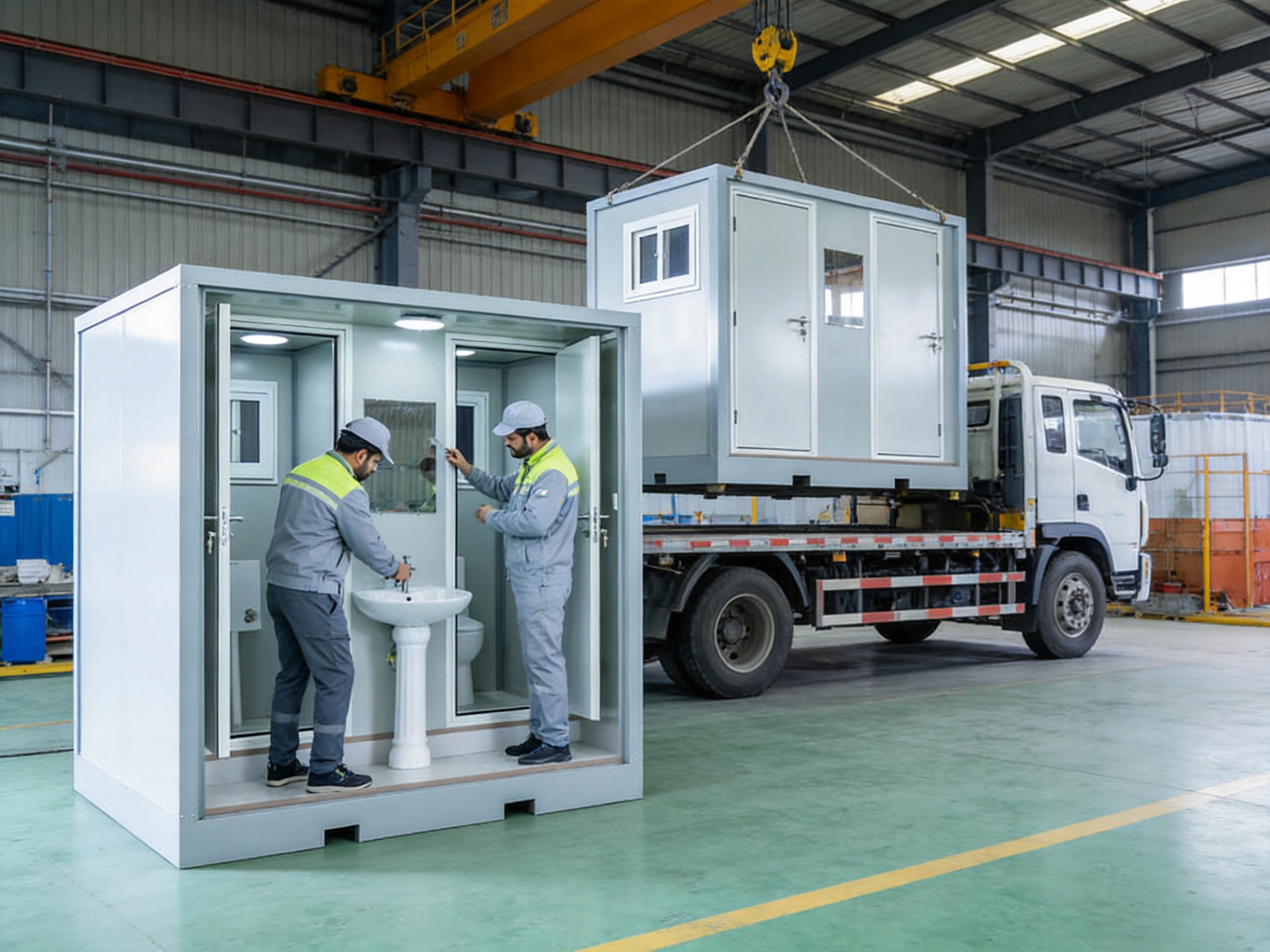
Access to clean, private, and dependable sanitation is essential wherever people gather, work, travel, or respond to an emergency. Outdoor events, construction sites, campsites, temporary settlements, and disaster-relief operations often require restroom facilities that can be deployed quickly without the time, cost, and complexity of permanent construction. The Two-Person Outdoor Portable Toilet is designed to meet this need with a compact, durable, and ready-to-use structure that combines privacy, hygiene, lighting, portability, and operational convenience.
Unlike a conventional single-cubicle portable toilet, this unit provides separate male and female compartments in one coordinated facility. It is more organized than placing several independent units across a site, while remaining substantially more flexible than constructing a permanent restroom building. The integrated design also includes an external handwashing sink and a built-in lighting system, supporting better hygiene and safer use during nighttime or low-light conditions.
The product is developed for situations in which sanitation facilities must be delivered efficiently and used immediately. Its pre-assembled approach reduces on-site work, while its robust structure is intended to withstand outdoor conditions and frequent relocation. These characteristics make it suitable for temporary projects and recurring applications in which the facility may need to move from one location to another.
Manufactured by Suzhou Taimao Integrated Housing Co., Ltd., the Two-Person Outdoor Portable Toilet benefits from the company’s broader experience in prefabricated, modular, and integrated building solutions. The company combines modular design, controlled factory production, integrated building technologies, and digital support to improve manufacturing consistency and shorten deployment time. Although this product is designed specifically for sanitation rather than accommodation, it reflects the same practical principles used in modern prefabricated construction: produce more in the factory, simplify work on site, and deliver a dependable finished solution with fewer installation steps.
Content
- 1 1. Understanding the Two-Person Outdoor Portable Toilet
- 2 2. Main Advantages Over Conventional Portable Restrooms
- 3 3. Applications Across Different Outdoor Environments
- 4 4. Product Design and Functional Performance
- 5 5. Manufacturing Strengths Behind the Product
- 6 6. Quality, Safety, and Operational Considerations
- 7 7. Sustainability and Efficient Resource Use
- 8 8. Procurement and Customization Guidance
- 9 9. Why Integrated Manufacturing Matters to Buyers
- 10 10. Comparing the Product with Other Sanitation Options
- 11 11. Recommended Operating Workflow
- 12 12. Frequently Asked Questions
- 12.1 Q1: What is the primary purpose of the Two-Person Outdoor Portable Toilet?
- 12.2 Q2: Does the unit include separate male and female compartments?
- 12.3 Q3: Is a handwashing station included?
- 12.4 Q4: Can the restroom be used at night?
- 12.5 Q5: Is the product delivered fully assembled?
- 12.6 Q6: Can the unit be relocated?
- 12.7 Q7: What makes this product different from a basic portable toilet?
- 12.8 Q8: Is this product suitable for construction sites?
- 12.9 Q9: Can it be used for disaster relief?
- 12.10 Q10: How should the unit be maintained?
- 12.11 Q11: Can customers discuss project-specific requirements?
- 12.12 Q12: Who manufactures the Two-Person Outdoor Portable Toilet?
- 13 13. Supplier Capabilities and Customer Support
- 14 14. Conclusion
- 15 References
- 16 Product: Two-Person Outdoor Portable Toilet
1. Understanding the Two-Person Outdoor Portable Toilet
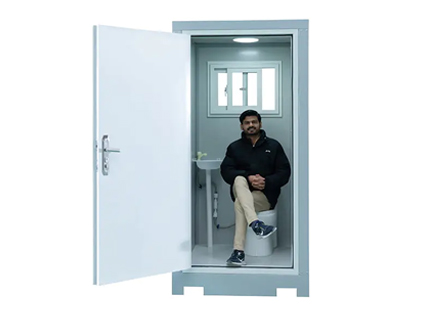
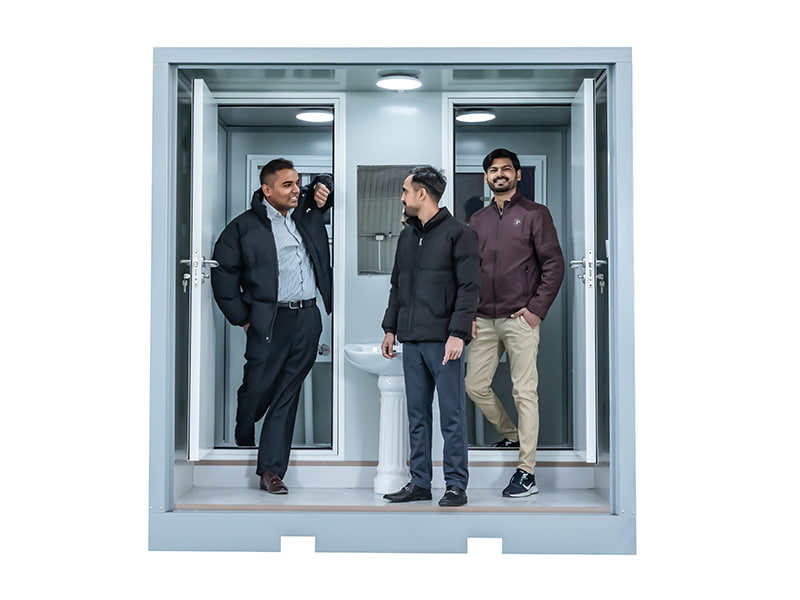
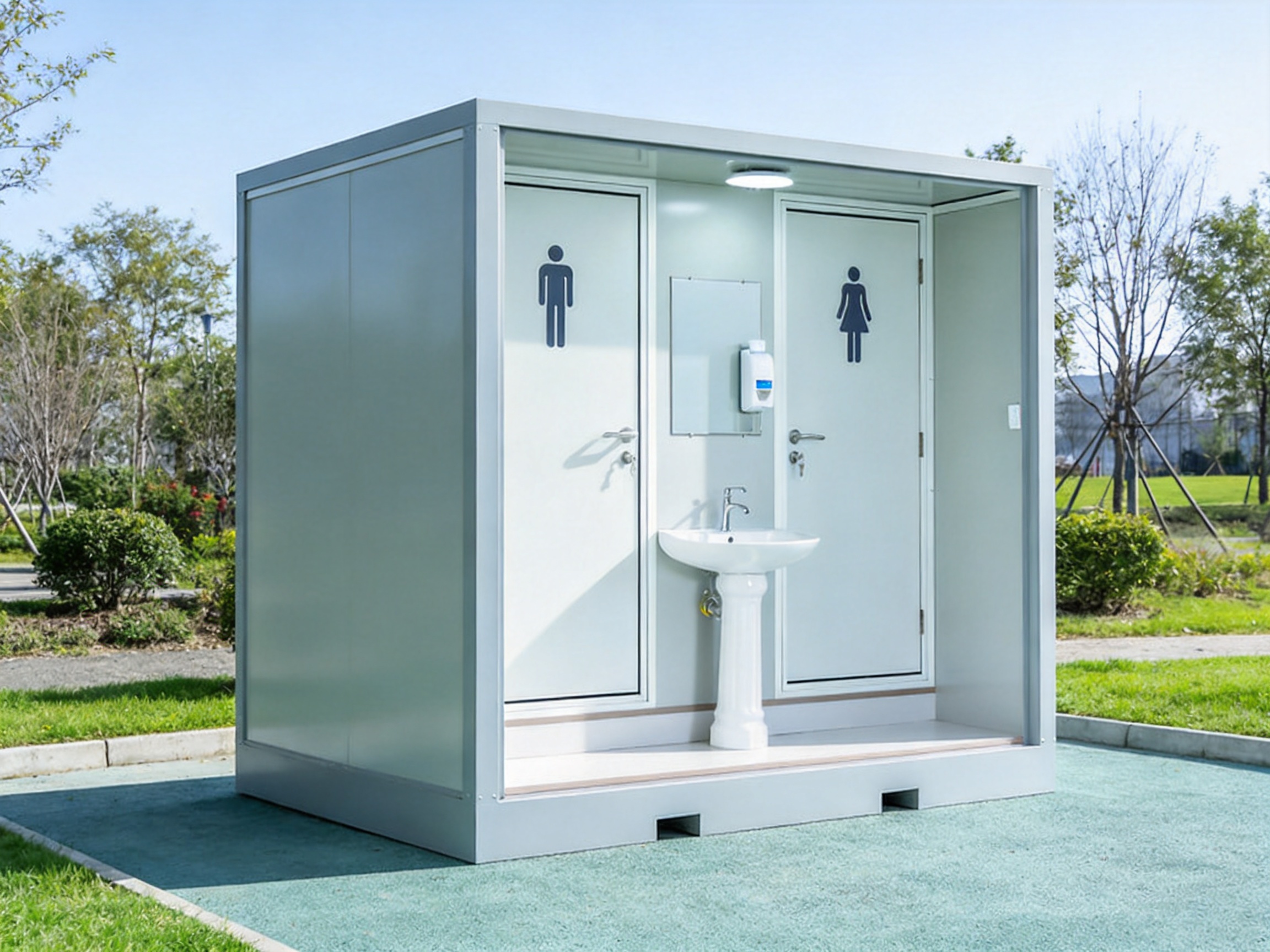
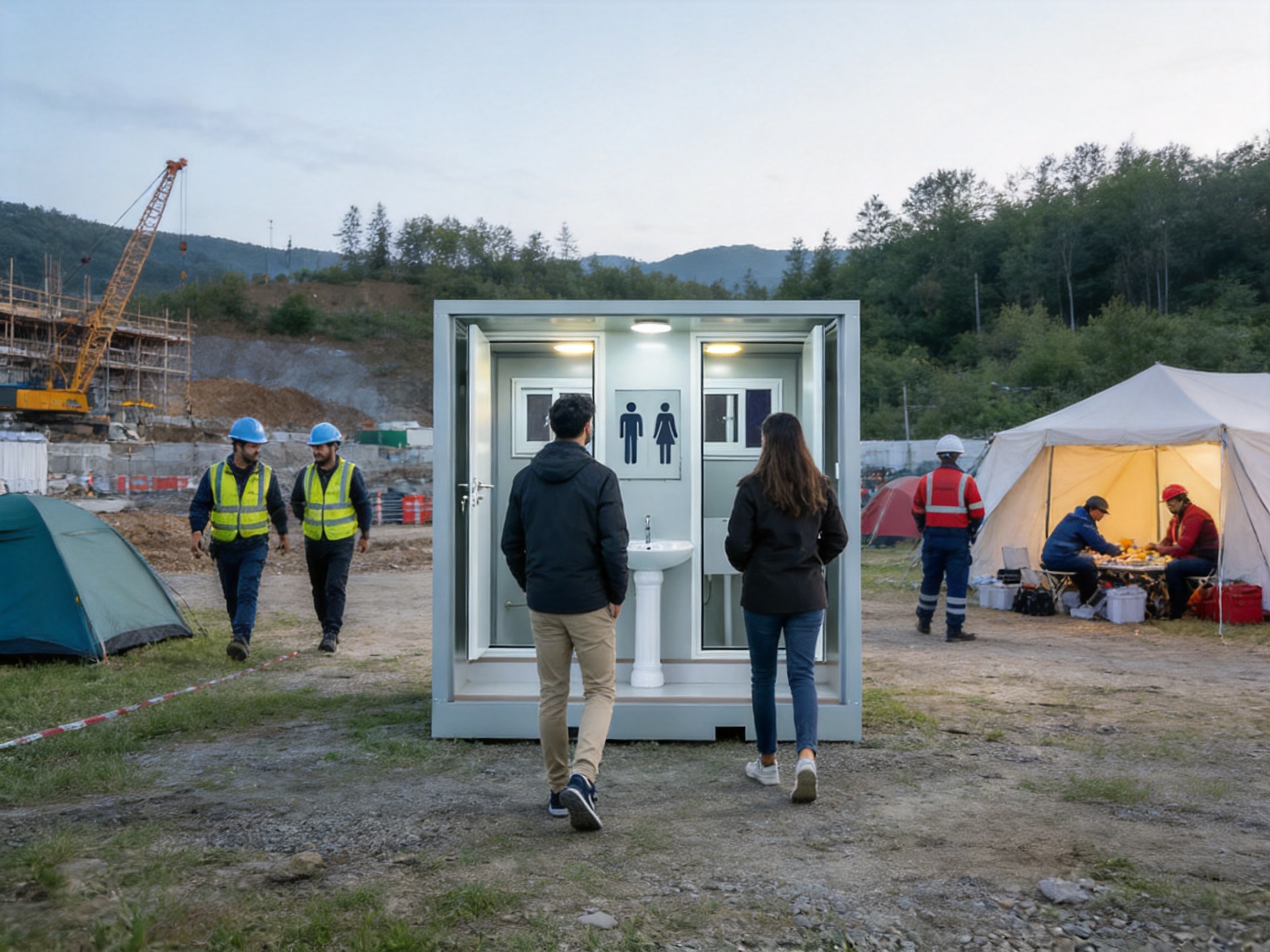
The Two-Person Outdoor Portable Toilet is a compact mobile restroom facility designed for use in outdoor and temporary environments. It contains two independent compartments, one for male users and one for female users. This arrangement provides a clearer separation of use than a shared single-room facility and can help improve privacy and user comfort in public or semi-public settings.
The unit is not a modular home, container room, or temporary accommodation building. Its primary purpose is portable sanitation. This distinction is important because the design priorities are different. Instead of providing living, sleeping, or working areas, the product concentrates on restroom access, user privacy, hygiene, lighting, durability, and rapid deployment.
A portable restroom must perform reliably under demanding conditions. It may be installed at a construction site during the early stages of a project, placed near an outdoor festival, used at a campsite, or deployed during emergency operations. In each case, users need a facility that is simple to access, easy to understand, and sufficiently stable for repeated daily use. Site managers also need a product that can be transported, positioned, maintained, and relocated without unnecessary construction work.
The Two-Person Outdoor Portable Toilet addresses these requirements through a coordinated structure rather than a collection of unrelated accessories. The male and female compartments, lighting system, and external sink are arranged as part of one facility. This helps create a more complete sanitation station while reducing the need to install multiple separate products.
1.1 Separate Male and Female Compartments
The dual-compartment layout is one of the product’s most important advantages. Separate male and female restrooms provide a more orderly arrangement for users and support privacy in locations where many people may need access to sanitation at the same time.
For event organizers, the division between compartments can make the facility easier to identify and manage. At construction sites, it provides a more practical alternative to assigning a single shared unit to a mixed workforce. During emergency response, the two-compartment arrangement allows planners to create a basic sanitation point that recognizes privacy requirements without requiring a large permanent installation.
Compared with a single portable toilet, the two-person configuration offers more functionality within one compact structure. Compared with several independent units, it can provide a more unified appearance and a more centralized handwashing and lighting arrangement. The result is a facility that makes efficient use of limited outdoor space.
1.2 External Handwashing Sink
Hand hygiene is a fundamental part of any sanitation system. A restroom without a convenient handwashing point may not adequately support hygienic use, particularly in crowded outdoor settings. The Two-Person Outdoor Portable Toilet includes an external handwashing sink to encourage users to clean their hands immediately after using the facility.
Positioning the sink externally makes it accessible without requiring users to re-enter a compartment. It also makes the handwashing function visible to users and site managers. For outdoor events, this can help create a more complete restroom station. At construction sites, it gives workers a convenient location to wash their hands before returning to work. In temporary or emergency environments, the external sink provides an important hygiene feature within a compact footprint.
The inclusion of a sink also distinguishes this product from basic portable toilet units that focus only on the toilet compartment. By integrating handwashing into the overall facility concept, the product supports a more complete user experience and helps operators reduce the need for separate handwashing equipment.
1.3 Built-In Lighting System
Outdoor facilities are often used during early morning, evening, nighttime, or poor-weather conditions. Insufficient lighting can make a restroom difficult to find and may create safety concerns around entrances, pathways, and interior spaces. The built-in lighting system of the Two-Person Outdoor Portable Toilet is intended to support safer use in low-light conditions.
Integrated lighting is especially valuable at construction sites where work schedules may extend beyond daylight hours. It is also useful at festivals, campsites, outdoor venues, and emergency locations where electrical infrastructure may be limited or temporary. Because the lighting is part of the facility rather than an afterthought, operators can plan the restroom installation as a more complete and usable unit.
Lighting can also improve user confidence. A clearly visible facility is easier to approach, while illuminated compartments provide a more comfortable environment than a dark or poorly marked portable unit. In temporary operations, this combination of visibility and convenience can make the facility more practical for a wider range of users.
2. Main Advantages Over Conventional Portable Restrooms
Portable sanitation products vary greatly in design and capability. Some are intended for short-term, low-volume use and provide only a basic enclosed compartment. Others are larger trailer-based systems that offer more features but require greater transportation capacity, more complex positioning, and higher operating costs. The Two-Person Outdoor Portable Toilet occupies a practical middle position: it provides more functionality than a basic single unit while maintaining the advantages of compact mobile deployment.
| Feature | Two-Person Outdoor Portable Toilet | Basic Single Portable Toilet | Permanent Restroom Building |
|---|---|---|---|
| Separate male and female areas | Included in one facility | Usually not available in one unit | Normally available |
| Handwashing station | External sink included | May require separate equipment | Usually integrated |
| Lighting | Built-in lighting system | Often limited or absent | Normally integrated into building services |
| Deployment speed | Designed for rapid placement and use | Rapid placement | Requires construction and utility work |
| Relocation flexibility | Suitable for movement between sites | Easy to relocate | Generally fixed |
| Privacy arrangement | Independent male and female compartments | Single-user compartment | Multiple rooms or stalls |
| Best application | Events, construction, camping, and emergency use | Short-term individual access | Long-term or permanent facilities |
2.1 More Complete Than a Basic Single Unit
A basic single portable toilet can provide essential access, but it may not be sufficient for a location with mixed users or a steady flow of people. When separate male and female facilities are required, operators may need to order several independent units, arrange them across the site, and install separate handwashing equipment and lighting.
The Two-Person Outdoor Portable Toilet brings these functions together. This can reduce the number of separate components that must be planned, transported, positioned, and maintained. It also provides a more recognizable and organized sanitation point for users.
The product does not attempt to replace every type of portable restroom. Instead, its advantage lies in balancing capacity and mobility. It is appropriate for customers who need more than a single basic cubicle but do not want the cost or logistical demands of a large restroom trailer or permanent building.
2.2 Faster Than Permanent Construction
Constructing a permanent restroom requires site preparation, foundations or other structural work, utility connections, plumbing, electrical installation, interior finishing, inspections, and ongoing construction coordination. These steps may be appropriate for a permanent facility, but they are often unsuitable for temporary projects or urgent requirements.
The Two-Person Outdoor Portable Toilet is pre-assembled for immediate use after deployment and final site preparation. This significantly reduces the amount of work required at the destination. The facility can be transported to the required location, positioned, connected or prepared according to the project’s operating arrangements, and placed into service without building a conventional restroom from the ground up.
Rapid deployment is particularly important for disaster relief, temporary work camps, public gatherings, and projects with compressed schedules. The ability to provide sanitation quickly can support workforce productivity, public comfort, and general site organization.
2.3 More Hygienic Than an Unintegrated Arrangement
When a portable toilet and handwashing station are supplied separately, the sink may be placed too far away, forgotten during installation, or inadequately maintained as an independent accessory. By including an external handwashing sink as part of the product configuration, the Two-Person Outdoor Portable Toilet makes hygiene a central design feature rather than an optional addition.
The external arrangement allows users to wash their hands after leaving the compartment. It can also make refill, inspection, and cleaning procedures easier for site personnel because the handwashing area is clearly associated with the restroom facility.
2.4 Safer and More Convenient at Night
Many temporary sanitation facilities are used outside normal daylight hours. A product without adequate lighting may become difficult to locate, uncomfortable to use, or less suitable for events and work sites operating after dark. The built-in lighting system provides an important operational advantage by supporting nighttime visibility and low-light use.
When combined with the unit’s separate compartments and stable structure, lighting helps the facility function as a dependable sanitation station throughout the day. This is particularly valuable in regions where outdoor activities continue into the evening or where emergency services must operate around the clock.
3. Applications Across Different Outdoor Environments
3.1 Construction Sites
Construction projects often begin before permanent buildings and utility networks are completed. Workers still require accessible restroom facilities from the first day of site activity. The Two-Person Outdoor Portable Toilet can be deployed during early construction stages and moved as the project layout changes.
Its durable structure is suited to outdoor conditions, while its portable configuration allows project managers to position the facility near active work areas without committing to permanent construction. The separate compartments support a mixed workforce, and the external sink encourages hand hygiene after restroom use.
The product may also be useful during renovation and expansion projects. Even when an existing building contains permanent restrooms, those facilities may be temporarily inaccessible, closed for refurbishment, or too far from the active work zone. A mobile sanitation unit can help maintain convenient access while construction work continues.
3.2 Outdoor Events
Concerts, sports activities, fairs, exhibitions, weddings, festivals, and community gatherings frequently require temporary restroom capacity. Event planners must consider crowd movement, privacy, hygiene, appearance, nighttime access, and the time available for setup and removal.
The Two-Person Outdoor Portable Toilet offers an organized alternative to placing isolated basic units throughout the venue. Its two-compartment design provides clearly differentiated access, while the integrated sink gives guests a convenient handwashing point. The lighting system supports evening events and improves the visibility of the facility.
Because it is portable, the unit can be positioned near visitor areas without requiring permanent site modification. After the event, it can be removed or relocated for another use. This flexibility is valuable for venues that host events only occasionally or that change their layout from one occasion to the next.
3.3 Camping Areas and Recreational Sites
Campsites and outdoor recreation areas may be located far from municipal sewer networks and permanent buildings. In these settings, sanitation facilities must be practical, durable, and easy to place in natural or temporary surroundings.
The Two-Person Outdoor Portable Toilet can serve campgrounds, temporary outdoor activity bases, and remote recreational areas where a fixed restroom building is not economically or logistically appropriate. Its lighting supports use after sunset, while its handwashing sink adds an important hygiene function for campers and visitors.
The unit’s ability to be relocated is also beneficial for seasonal operations. A campsite may require different arrangements during peak and off-peak periods, or a recreation provider may move facilities to support changing activity zones. A portable restroom allows the operator to adapt without building a new facility at every location.
3.4 Emergency and Disaster Relief
Natural disasters, infrastructure failures, humanitarian emergencies, and temporary evacuations can create an immediate demand for sanitation facilities. Permanent buildings may be damaged, inaccessible, or insufficient for the number of people requiring assistance. In such circumstances, speed and reliability are critical.
The Two-Person Outdoor Portable Toilet is designed for rapid deployment and can provide a basic but organized sanitation facility where it is needed. Separate compartments help protect privacy, the external sink supports hygiene, and lighting assists with nighttime use. Its mobile form allows relief coordinators to move or reposition the unit as camps, shelters, and service areas change.
Emergency sanitation planning must account for transportation, site access, maintenance, and the availability of supporting services. The product’s pre-assembled configuration can simplify the initial setup process and reduce the number of construction tasks required during a crisis.
3.5 Temporary Work Camps and Remote Projects
Mining, infrastructure, energy, agriculture, forestry, and other remote operations may establish temporary work camps far from established urban services. A portable restroom can provide a necessary facility without requiring a permanent building that may become redundant when the project ends.
The Two-Person Outdoor Portable Toilet is suitable for organizations that need a repeatable sanitation solution across multiple temporary locations. Its portability supports project mobility, while its integrated functions help reduce the need to source separate restroom, handwashing, and lighting components.
4. Product Design and Functional Performance
4.1 Compact Integrated Structure
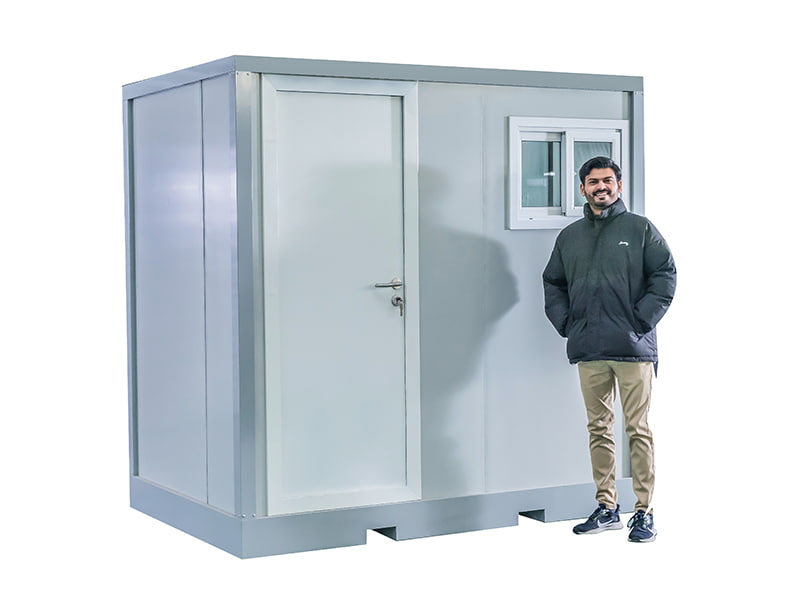
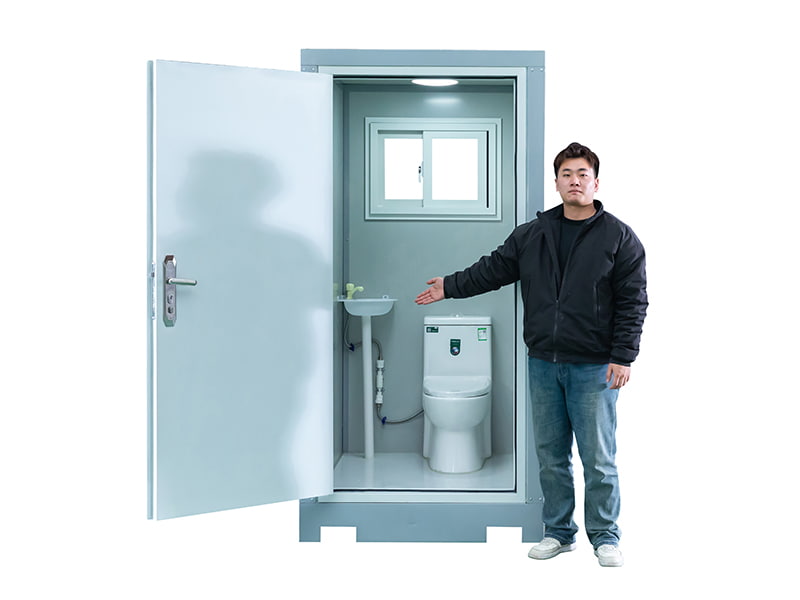
The product combines two restroom compartments and supporting features within one compact structure. This integrated form can help operators use land efficiently, especially at crowded event sites or constrained construction areas. It also simplifies the visual organization of a temporary facility area.
A compact structure does not mean that the unit is limited to minimal functionality. The product includes privacy separation, lighting, and external handwashing, making it more complete than a basic enclosure. The design is intended to provide practical convenience without the footprint of a permanent restroom building.
4.2 Robust and Stable Construction
Outdoor sanitation equipment must withstand repeated use, transportation, changing weather, and frequent relocation. The Two-Person Outdoor Portable Toilet is described as having a robust and stable structure capable of handling outdoor conditions and repeated movement between locations.
Structural stability is important for both safety and user confidence. A restroom facility that shifts, flexes excessively, or appears unstable can be uncomfortable to use and difficult to manage. A stable unit is easier to position and more suitable for use in busy public or work environments.
The structure’s outdoor-ready characteristics also support longer service potential when the unit is operated and maintained appropriately. Operators should still evaluate local site conditions, wind exposure, ground stability, drainage, weather severity, and applicable regulations before installation.
4.3 Ready-to-Use Deployment
Pre-assembly is a major part of the product’s value. Traditional site-built facilities require multiple trades and a series of construction stages. A pre-assembled portable unit reduces the amount of work that must be completed at the destination.
For customers, this means a simpler procurement and deployment process. Instead of coordinating a structure, interior fit-out, lighting installation, and handwashing equipment separately, the customer can plan around a single integrated product. This can reduce schedule risk and make it easier to estimate the resources needed for installation.
4.4 Flexible Relocation
Temporary facilities are often required in different positions over their service life. A construction site changes as buildings, roads, and work zones develop. An event venue may use different layouts for different programs. A relief camp may expand, contract, or move. The portability of the Two-Person Outdoor Portable Toilet allows it to respond to such changes.
Relocation flexibility can improve asset utilization. Rather than purchasing a new restroom for every project stage or location, an operator may move the same unit where demand is highest. This is a practical advantage over permanent facilities and can also be more efficient than maintaining multiple scattered basic units.
Two-Person Outdoor Portable Toilet
5. Manufacturing Strengths Behind the Product
The performance of a prefabricated product depends not only on its visible features but also on the manufacturing system used to produce it. Suzhou Taimao Integrated Housing Co., Ltd. specializes in integrated housing and modular building solutions. Its experience includes modular design, proprietary manufacturing technologies, digital software support, and factory-based production methods.
These capabilities are relevant to the Two-Person Outdoor Portable Toilet because the product follows the same general philosophy as other prefabricated structures: components and systems are coordinated before delivery, manufacturing is performed in a controlled environment, and on-site work is reduced to the essential deployment steps.
5.1 Modular Design Capability
Modular design requires careful coordination of structure, openings, internal functions, exterior elements, and transport considerations. Even a compact restroom facility must be designed as a complete system rather than as a collection of individual parts.
The company’s modular design experience supports the development of products that are repeatable, practical, and adaptable to different project environments. A modular approach can also facilitate customization when customers require adjustments related to appearance, layout, branding, site regulations, or project usage.
For international customers, modular design provides a useful foundation for discussing requirements in a structured way. The customer can identify intended capacity, operating environment, transport limitations, and required accessories before production. This helps align the final unit with the actual project rather than relying on an improvised site solution.
5.2 Controlled Factory Production
Factory production offers a more controlled environment than unrestricted on-site construction. Materials, assembly procedures, quality checks, and workflow can be organized under repeatable conditions. This can improve manufacturing consistency and reduce exposure to weather-related interruptions during production.
Factory-based assembly also allows different tasks to be coordinated efficiently. Structural work, enclosure installation, interior preparation, lighting integration, and accessory installation can be planned as part of a unified production sequence. The result is a finished unit that reaches the customer with a greater level of completion.
For a portable restroom, controlled production is especially useful because the unit must be compact yet functional. The manufacturer must coordinate the compartments, lighting, sink, structural stability, and transportation requirements within a limited form. A standardized factory process helps ensure that these elements are considered together.
5.3 Integration of Building Functions
The company’s broader SIP modular building system integrates structure, insulation, mechanical, electrical, plumbing, heating, ventilation, air conditioning, interior finishes, and smart home technologies into a unified solution. The Two-Person Outdoor Portable Toilet serves a more specialized function, but it reflects the same integrated approach.
Instead of treating the structure as an empty shell and leaving every functional element to be installed later, the product is prepared as a usable sanitation facility. Lighting and handwashing are incorporated into the product concept, while the compartments are designed to operate as a coordinated pair.
This integration reduces the risk that important functions will be overlooked during installation. It can also simplify communication between the manufacturer, distributor, contractor, and end user, since the principal functions are defined before the unit reaches the site.
5.4 Digital Software Support
Digital support can improve communication throughout the design and manufacturing process. Project information, layouts, technical requirements, and production details can be organized more clearly when supported by digital tools.
For customers ordering portable sanitation units for multiple projects, digital coordination can help manage product specifications and deployment planning. It may also support design review, production communication, and documentation. These processes are particularly useful for international orders, where clear technical communication is essential before manufacturing and shipment.
5.5 End-to-End Project Orientation
The company describes its mission as accelerating project timelines, improving operational efficiency, reducing ecological impact, and maintaining high standards of quality and safety. These objectives align well with the needs of temporary facility buyers.
A customer purchasing a portable restroom is not only buying a physical enclosure. The customer is also seeking a predictable process: clear product information, appropriate manufacturing, reliable shipment preparation, manageable deployment, and support for practical use. An end-to-end manufacturing orientation helps connect these stages instead of treating production as an isolated transaction.
6. Quality, Safety, and Operational Considerations
A portable restroom should be evaluated according to the conditions in which it will be used. The Two-Person Outdoor Portable Toilet is designed to be robust, stable, and weather resistant, but each installation still requires responsible site planning.
6.1 Site Selection
The unit should be placed on a stable and reasonably level surface that supports safe access and reduces the risk of movement. The chosen location should also allow users to approach the facility comfortably and permit service personnel to perform cleaning, inspection, and replenishment tasks.
Operators should consider drainage, ground conditions, access routes, proximity to work or event areas, lighting around the unit, and separation from food preparation or public seating areas. In emergency situations, planners should select a location that balances accessibility with privacy and hygiene management.
6.2 Weather and Outdoor Exposure
Outdoor facilities may experience rain, wind, heat, cold, dust, and repeated changes in weather. The product’s robust and weather-resistant structure is intended to support outdoor use, but appropriate installation and maintenance remain essential.
In areas with severe weather, site managers should follow suitable anchoring, stabilization, drainage, and local safety procedures. The unit should be inspected after major weather events and before returning to heavy public use. These practices help protect the structure and maintain user confidence.
6.3 Lighting and Electrical Planning
The built-in lighting system improves use in low-light conditions, but operators should confirm the project’s power arrangements and follow applicable electrical safety requirements. Depending on the destination and configuration, the facility may require a suitable power connection or other approved operating arrangement.
Cables, switches, connections, and lighting components should be inspected by qualified personnel when necessary. Temporary installations should be organized to minimize trip hazards and protect electrical equipment from moisture or accidental damage.
6.4 Cleaning and Maintenance
Regular cleaning is essential for any shared restroom. The frequency of service should reflect the number of users, duration of operation, weather, event type, and available sanitation resources. High-traffic events require more frequent inspection than low-use temporary locations.
Maintenance planning should include cleaning of the compartments, replenishment of handwashing supplies, inspection of the sink, removal of waste according to local procedures, checking of lighting, and examination of structural components. A clear maintenance schedule can extend service life and improve the user experience.
7. Sustainability and Efficient Resource Use
Temporary construction can create unnecessary waste when facilities are built for short-term use and demolished soon afterward. A relocatable portable restroom offers a different approach by allowing one facility to support several projects or events over time.
The ability to move the unit can increase asset utilization and reduce the need to construct a separate permanent restroom for every temporary application. Factory production may also improve material planning and reduce the inefficiencies associated with uncontrolled site construction.
The company’s broader modular building mission emphasizes minimizing ecological impact. In the context of this product, more efficient prefabrication, repeatable manufacturing, and relocation flexibility can contribute to a practical sustainability strategy. Customers should also consider responsible waste handling, water use, cleaning chemicals, transport planning, and end-of-life recycling or disposal when evaluating the complete environmental profile.
Sustainability does not mean sacrificing durability. A product that can withstand repeated movement and continued use may offer better resource efficiency than a low-cost unit that must be frequently replaced. For this reason, structural stability, maintenance, and long-term usability are important parts of an environmentally responsible purchasing decision.
8. Procurement and Customization Guidance
Before ordering a Two-Person Outdoor Portable Toilet, customers should define how and where the facility will be used. Important considerations include the expected number of users, operating period, transportation route, installation surface, weather conditions, available utilities, service schedule, and local sanitation requirements.
8.1 Questions for Project Planning
Customers should determine whether the unit will serve a construction site, an event, a campsite, a remote work area, or an emergency response operation. Each application may have different requirements for access, cleaning, privacy, lighting, placement, and relocation.
The customer should also identify whether the unit will be used continuously or periodically. Seasonal events may require a different logistics plan from a construction project that operates for many months. Similarly, emergency deployments may prioritize speed and transport simplicity above all other considerations.
8.2 Transportation and Delivery
Since portability is a central product advantage, transportation planning should be completed before shipment. The buyer should confirm access for delivery vehicles, unloading equipment, temporary storage areas, and the route from the delivery point to the final installation position.
International customers should discuss packaging, shipping dimensions, customs documentation, destination regulations, and unloading responsibilities with the supplier. Clear communication at this stage can reduce delays and ensure that the receiving site is prepared.
8.3 Local Regulations
Sanitation, wastewater, electrical, accessibility, fire safety, and temporary structure requirements may vary by country, region, municipality, and project type. The product should be reviewed against applicable local regulations before purchase and installation.
The manufacturer can provide product information for technical review, while the customer or local contractor remains responsible for confirming site-specific compliance. This division of responsibility is important for safe and lawful operation.
8.4 Potential Custom Requirements
Depending on the project, buyers may wish to discuss exterior colors, signage, layout details, accessory arrangements, transport requirements, or other practical adjustments. Customization should be evaluated during the design stage so that it can be incorporated into manufacturing rather than added through improvised site work.
The company’s experience with modular and prefabricated buildings provides a foundation for discussing project-specific solutions. Customers should provide accurate information about the intended location, climate, user group, operating period, and deployment method to support an appropriate design conversation.
9. Why Integrated Manufacturing Matters to Buyers
Buyers of temporary sanitation facilities often face pressure to reduce project delays and simplify coordination. An integrated manufacturing model can address these concerns by bringing design, production, and functional preparation into one organized process.
When the structure and major features are produced as a coordinated unit, the customer does not need to manage as many separate suppliers. This may reduce communication gaps between the structural contractor, electrical installer, sanitation equipment provider, and site team. It can also make it easier to identify responsibilities before delivery.
Integrated manufacturing can support repeatability as well. Organizations that require multiple units or recurring deployments may benefit from consistent product configurations, standardized documentation, and a familiar installation process. Consistency is useful for event companies, construction groups, emergency agencies, accommodation operators, and facility rental providers.
The company’s experience in modular housing and integrated construction strengthens its ability to approach the portable restroom as a complete building product. Its manufacturing philosophy is not limited to producing individual components. Instead, the focus is on preparing a functional, coordinated facility that can be moved from factory production to practical site use with minimal additional work.
10. Comparing the Product with Other Sanitation Options
10.1 Against Single-Cubicle Portable Toilets
Single-cubicle units are useful when a project requires basic individual access at the lowest possible scale. However, they may require several units to provide separate male and female facilities. They may also lack integrated lighting and handwashing.
The Two-Person Outdoor Portable Toilet provides a more complete arrangement in one structure. It is particularly suitable when privacy separation, nighttime use, and hygiene facilities are priorities. Its value is therefore measured not only by the number of toilet compartments but by the combined functionality delivered to the site.
10.2 Against Restroom Trailers
Restroom trailers can offer extensive amenities and a more permanent interior experience, but they may require larger vehicles, specialized towing, greater setup space, and more complex logistics. They may also be excessive for a small construction site, campsite, or emergency location.
The Two-Person Outdoor Portable Toilet provides a more compact alternative for customers who need essential functionality without the scale of a trailer-based facility. Its smaller and more straightforward format can be advantageous where access roads, available space, or budget are limited.
10.3 Against Permanent Restroom Buildings
Permanent buildings are appropriate for long-term facilities with stable locations and established utilities. They can provide greater capacity and more extensive amenities, but they require significant investment, construction time, and site commitment.
The portable unit is better suited to temporary or changing requirements. It can provide sanitation while a permanent project is being developed, support seasonal operations, or serve locations where construction would not be practical. It should not be viewed as a universal replacement for a permanent facility, but as a flexible solution for applications where mobility and speed are essential.
11. Recommended Operating Workflow
A successful deployment begins with planning. The operator should confirm the expected usage level, select an appropriate location, prepare the surface, arrange transport and unloading, and verify any local requirements before the unit arrives.
After delivery, the unit should be positioned securely and inspected. The compartments, entrances, lighting system, external sink, and structural condition should be checked before opening the facility to users. Necessary water, power, waste, and cleaning arrangements should be established according to the project’s operating model.
During use, staff should inspect the facility at regular intervals. High-traffic events may require a dedicated maintenance team, while a small construction site may use a scheduled inspection routine. The facility should remain clean, illuminated, accessible, and supplied with the materials needed for handwashing.
When relocation is required, the unit should be prepared carefully. Cleaning, emptying, disconnecting relevant services, securing movable elements, and inspecting the structure before transport can reduce the risk of damage. Once moved, the same deployment checks should be performed again at the new location.
12. Frequently Asked Questions
Q1: What is the primary purpose of the Two-Person Outdoor Portable Toilet?
The primary purpose is to provide a compact, mobile, and ready-to-use sanitation facility for outdoor and temporary applications. It is designed for events, construction sites, campsites, emergency operations, remote projects, and other locations where a permanent restroom is unavailable or impractical.
Q2: Does the unit include separate male and female compartments?
Yes. The facility includes independent male and female compartments. This arrangement improves privacy and provides a more organized solution for mixed-user environments.
Q3: Is a handwashing station included?
Yes. An external handwashing sink is included as part of the product configuration. It is intended to encourage hand hygiene and provide users with convenient access to washing facilities after restroom use.
Q4: Can the restroom be used at night?
Yes. The unit includes a built-in lighting system designed to support use during nighttime and other low-light conditions. Operators should confirm the appropriate power and safety arrangements for the installation site.
Q5: Is the product delivered fully assembled?
The unit is pre-assembled for rapid deployment and immediate use after the necessary site arrangements are completed. The exact delivery and setup procedure should be confirmed according to the destination, transportation method, utilities, and local requirements.
Q6: Can the unit be relocated?
Yes. Portability and relocation are central features of the product. It can be transported and repositioned for changing construction phases, seasonal events, emergency camps, or other temporary applications. Relocation should be conducted using suitable equipment and safe handling procedures.
Q7: What makes this product different from a basic portable toilet?
The Two-Person Outdoor Portable Toilet provides two separate compartments, an external handwashing sink, built-in lighting, and a robust integrated structure. A basic portable toilet may offer only one enclosed compartment and may require separate solutions for lighting and handwashing.
Q8: Is this product suitable for construction sites?
Yes. Its durable, stable, portable, and ready-to-use characteristics make it suitable for construction sites, including projects where permanent buildings and utilities are still under development. It can also be relocated as the site layout changes.
Q9: Can it be used for disaster relief?
Yes. The product is designed for temporary and emergency sanitation needs. Its rapid deployment, separate compartments, handwashing sink, lighting, and mobility make it suitable for disaster-relief areas, temporary shelters, and emergency work locations, subject to local site and sanitation planning.
Q10: How should the unit be maintained?
Maintenance should include regular cleaning, inspection of the compartments, replenishment of handwashing supplies, checking of the sink and lighting system, proper waste management, and examination of the structure. The required service frequency depends on usage volume and operating conditions.
Q11: Can customers discuss project-specific requirements?
Yes. Customers should discuss intended use, climate, transportation, layout, deployment conditions, local regulations, and possible customization requirements with the manufacturer before production. Early technical communication helps ensure that the selected configuration is suitable for the project.
Q12: Who manufactures the Two-Person Outdoor Portable Toilet?
The product is manufactured by Suzhou Taimao Integrated Housing Co., Ltd., a Chinese supplier specializing in modular building solutions, prefabricated structures, integrated housing, and related manufacturing technologies.
13. Supplier Capabilities and Customer Support
Suzhou Taimao Integrated Housing Co., Ltd. serves customers seeking modular, prefabricated, and portable building solutions. Its company information emphasizes globally certified modular building solutions, proprietary manufacturing technologies, digital software support, and factory-controlled production.
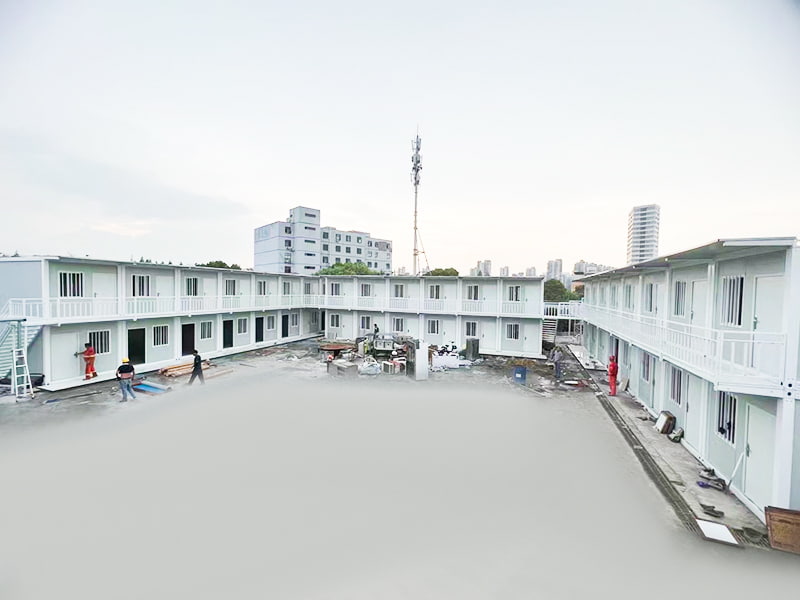
The company’s product range includes integrated housing solutions and different types of prefabricated structures. This broader product background is valuable because portable sanitation often forms part of a larger temporary project. A construction site, emergency camp, event area, or remote work location may require not only toilets but also portable offices, accommodation, storage, dining areas, or other modular facilities.
By working with a supplier experienced in integrated housing, customers may be able to coordinate related temporary facilities through a more unified manufacturing partner. This can simplify project discussions and support consistent approaches to design, production, transportation, and deployment.
The company’s stated mission also emphasizes shorter project timelines, improved operational efficiency, reduced ecological impact, and quality and safety. These priorities align with the practical expectations of portable facility buyers, who typically require a product that can be delivered efficiently and placed into operation without unnecessary delay.
14. Conclusion
The Two-Person Outdoor Portable Toilet is a practical response to the growing need for flexible sanitation infrastructure. It combines separate male and female compartments, an external handwashing sink, built-in lighting, a stable structure, and portable deployment in one coordinated facility.
Its advantages are most apparent when compared with basic single portable toilets, separate accessory arrangements, and permanent buildings that require lengthy construction. The unit provides more functionality than a basic cubicle while avoiding the time, cost, and fixed-location commitment associated with permanent construction. It is also more compact and straightforward than a large restroom trailer for projects that require essential sanitation rather than extensive amenities.
The product is suitable for construction sites, outdoor events, campsites, temporary work camps, remote projects, and emergency or disaster-relief operations. In each application, its value comes from the combination of privacy, hygiene, lighting, durability, and mobility.
Behind the product is a manufacturing approach based on modular design, controlled factory production, integrated building functions, digital support, and end-to-end project coordination. Suzhou Taimao Integrated Housing Co., Ltd. applies its experience in prefabricated and modular construction to create solutions that reduce on-site work and support faster deployment.
For organizations that need dependable temporary sanitation, the Two-Person Outdoor Portable Toilet offers a balanced solution: compact enough for flexible placement, complete enough for practical daily use, and robust enough for demanding outdoor environments. With proper site preparation, service planning, and maintenance, it can support safer, cleaner, and more organized temporary facilities across a wide range of projects.
References
1. Product information provided for the Two-Person Outdoor Portable Toilet, including product features, applications, and deployment characteristics.
2. Company information provided by Suzhou Taimao Integrated Housing Co., Ltd. regarding modular design, integrated manufacturing, prefabricated construction, and digital project support.
3. General principles of temporary sanitation planning for construction sites, outdoor events, campsites, remote projects, and emergency operations.
4. General guidance on portable facility placement, hygiene management, lighting safety, structural stability, and routine maintenance.
5. General principles of modular and prefabricated construction, including factory-controlled production, integrated building systems, and reduced on-site assembly.
Product: Two-Person Outdoor Portable Toilet
For exclusive deals and latest offers, sign up by entering your email address below.

-
TEL:+86 18762912902
-
Email:cntaimao@163.com
-
WhatsApp:
-
Add:Group 5, Cao Village, Zhenze Town, Suzhou, Jiangsu, China
Copyright © Suzhou Taimao Integrated Housing Co., Ltd.
All Rights Reserved.
 Wholesale movable homes for sale
custom built modular homes
Wholesale movable homes for sale
custom built modular homes