

 EN
EN
 русский
 Español
 عربى
عربى Français
Two-Person Outdoor Portable Toilet: A Practical Sanitation Solution for Events, Construction, and Emergency Use
Admin 2026-08-20Reliable sanitation is one of the first requirements for any temporary outdoor project. Construction sites, festivals, sports events, campsites, public gatherings, disaster-relief operations, and remote work areas all need clean, safe, and accessible toilet facilities. When permanent plumbing or conventional buildings are unavailable, a portable restroom can provide an efficient alternative. However, not every portable toilet offers the same level of privacy, usability, durability, and deployment flexibility.
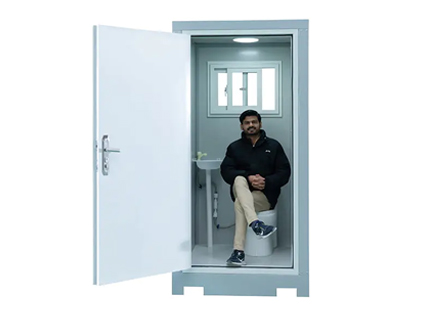
The Two-Person Outdoor Portable Toilet is designed as a compact mobile restroom solution for situations where fast installation, independent compartments, and dependable outdoor performance are essential. The unit combines separate male and female compartments, built-in lighting, an external handwashing sink, and a stable weather-resistant structure. It arrives pre-assembled for rapid deployment and can be transported or relocated as project requirements change.
Unlike a simple single-cabin chemical toilet, this product is organized as a small, complete sanitation station. It is intended to support two users at the same time while improving privacy and operational convenience. Its design also distinguishes it from container houses, modular accommodation units, and other temporary buildings. The primary purpose of this product is sanitation, and its structure, features, and manufacturing process are all focused on delivering a ready-to-use outdoor restroom.
Content
- 1 What Is a Two-Person Outdoor Portable Toilet?
- 2 Why Dual Compartments Matter
- 3 Built-In Lighting for Day and Night Operation
- 4 External Handwashing Sink and Hygiene Support
- 5 Robust Construction for Outdoor Environments
- 6 Pre-Assembled Design and Quick Deployment
- 7 Applications Across Different Industries
- 8 Advantages Compared with Basic Portable Toilets
- 9 Advantages Compared with Permanent Restroom Construction
- 10 Manufacturing Strengths of Suzhou Taimao Integrated Housing Co., Ltd.
- 11 Production Process for a Portable Restroom Unit
- 12 Quality Control and Delivery Preparation
- 13 Environmental and Efficiency Considerations
- 14 How the Unit Supports Different Project Sizes
- 15 Installation and Site Planning Considerations
- 16 Maintenance and Long-Term Use
- 17 How to Choose a Supplier
- 18 Customization and Project Coordination
- 19 Frequently Asked Questions
- 19.1 What is the main purpose of this product?
- 19.2 Why is it called a two-person toilet?
- 19.3 Does the unit include a handwashing station?
- 19.4 Can it be used at night?
- 19.5 Is the portable toilet delivered assembled?
- 19.6 Can the unit be moved to another location?
- 19.7 Where can this product be installed?
- 19.8 Is it suitable for a large festival?
- 19.9 How does it compare with a single-cabin portable toilet?
- 19.10 Is it a replacement for a permanent restroom building?
- 19.11 What maintenance does it require?
- 19.12 Can the manufacturer supply other temporary buildings?
- 19.13 What should buyers provide when requesting a quotation?
- 20 Conclusion
- 21 References
- 22 Product: Two-Person Outdoor Portable Toilet
What Is a Two-Person Outdoor Portable Toilet?
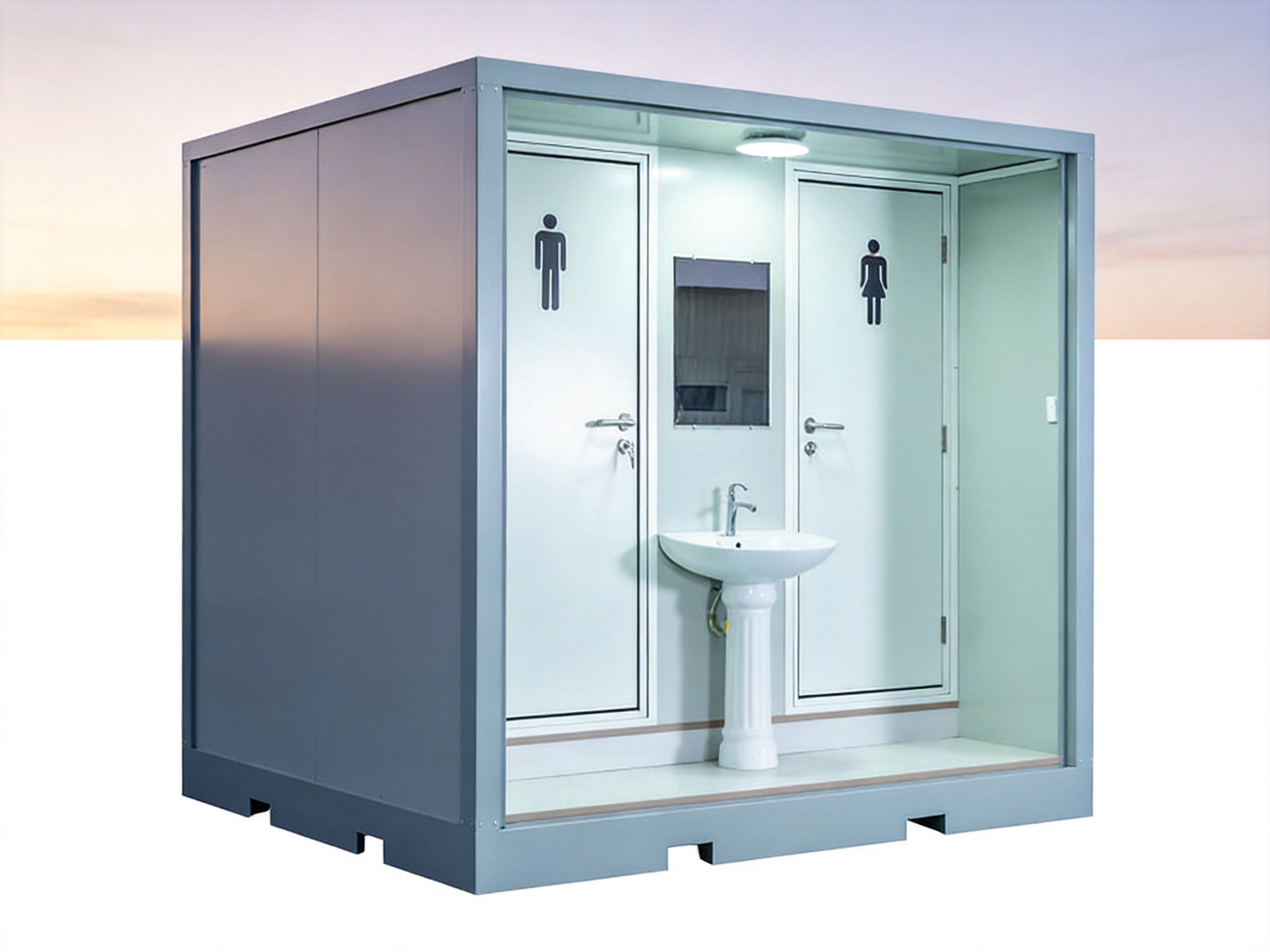
A two-person outdoor portable toilet is a mobile restroom unit containing two independent compartments. In this configuration, the compartments are arranged to provide separate male and female facilities. Each user can access a private space without sharing a single interior room or waiting for one cubicle to become available.
The unit is suitable for temporary or semi-temporary applications. It can be placed at an outdoor event, near a construction work zone, beside a camping area, or in a location affected by an emergency. Because it is pre-assembled, users do not need to construct a complete restroom building on site before the unit can be used. This reduces the time between delivery and operation.
Several features work together to create a more complete sanitation solution:
Separate male and female compartments support privacy, organization, and simultaneous use.
Built-in lighting helps users enter and use the facility at night or in low-light conditions.
An external handwashing sink encourages hygiene after restroom use and reduces the need for a separate washing station.
A robust and stable structure is designed for repeated relocation and exposure to outdoor conditions.
Pre-assembled construction simplifies installation and supports quick deployment.
Portable construction allows the facility to be moved when an event ends, a work area changes, or emergency requirements develop in another location.
These characteristics make the unit appropriate for customers who need more than a basic portable toilet but do not want to build a permanent restroom or install a complete modular building.
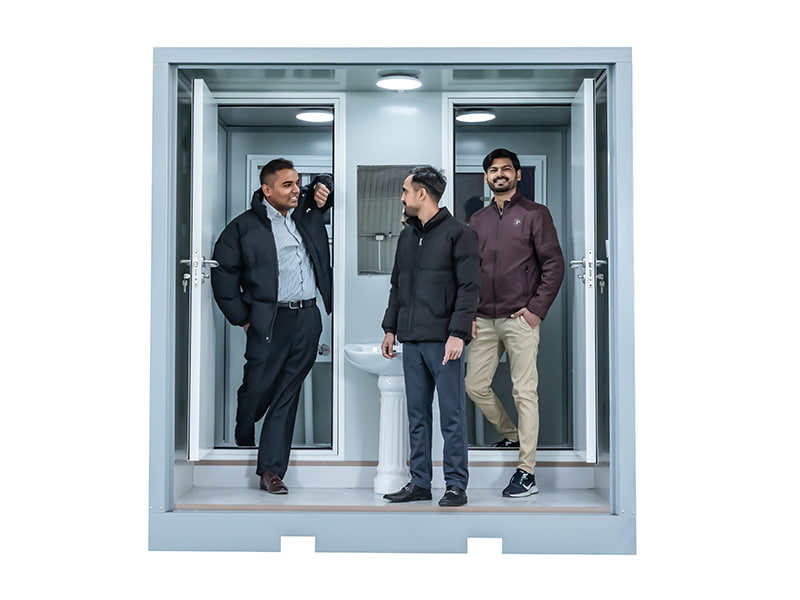
Two-Person Outdoor Portable Toilet
Why Dual Compartments Matter
Privacy and user organization are important considerations in public and temporary sanitation. A single shared cabin can create queues, inconvenience, and discomfort, especially when an event serves people from different groups or when a work site operates for extended hours. The two-compartment layout addresses this issue by providing independent male and female restrooms within one compact unit.
The dual-compartment arrangement also improves the efficiency of a temporary facility. Two people can use the unit at the same time, which can help reduce waiting during busy periods. This is valuable at outdoor events, where attendance may increase sharply during intermissions or peak hours. It is also helpful on construction sites, where workers may have limited break time and cannot travel long distances to reach a restroom.
Separate entrances or clearly organized access points can help users identify the appropriate compartment quickly. Depending on the project layout and local requirements, the operator can position the unit in a visible and convenient location while preserving a practical flow of movement around the facility.
Compared with a single-cabin portable toilet, a two-person unit can provide a better balance between footprint and capacity. Instead of placing two completely separate units side by side, a customer may be able to deploy one integrated facility. This can simplify transportation, positioning, site planning, and routine management.
Privacy for Temporary Facilities
Temporary does not have to mean uncomfortable or poorly organized. Users expect a reasonable level of privacy even when a restroom is installed at a short-term location. Independent compartments help create a more orderly environment and make the facility suitable for events, work camps, and relief applications where users may remain on site for many hours or days.
The enclosed structure also offers a more defined restroom experience than an exposed or improvised toilet area. A stable enclosure provides a sense of separation from surrounding activities, which is particularly important at public events, commercial sites, and populated construction areas.
Built-In Lighting for Day and Night Operation
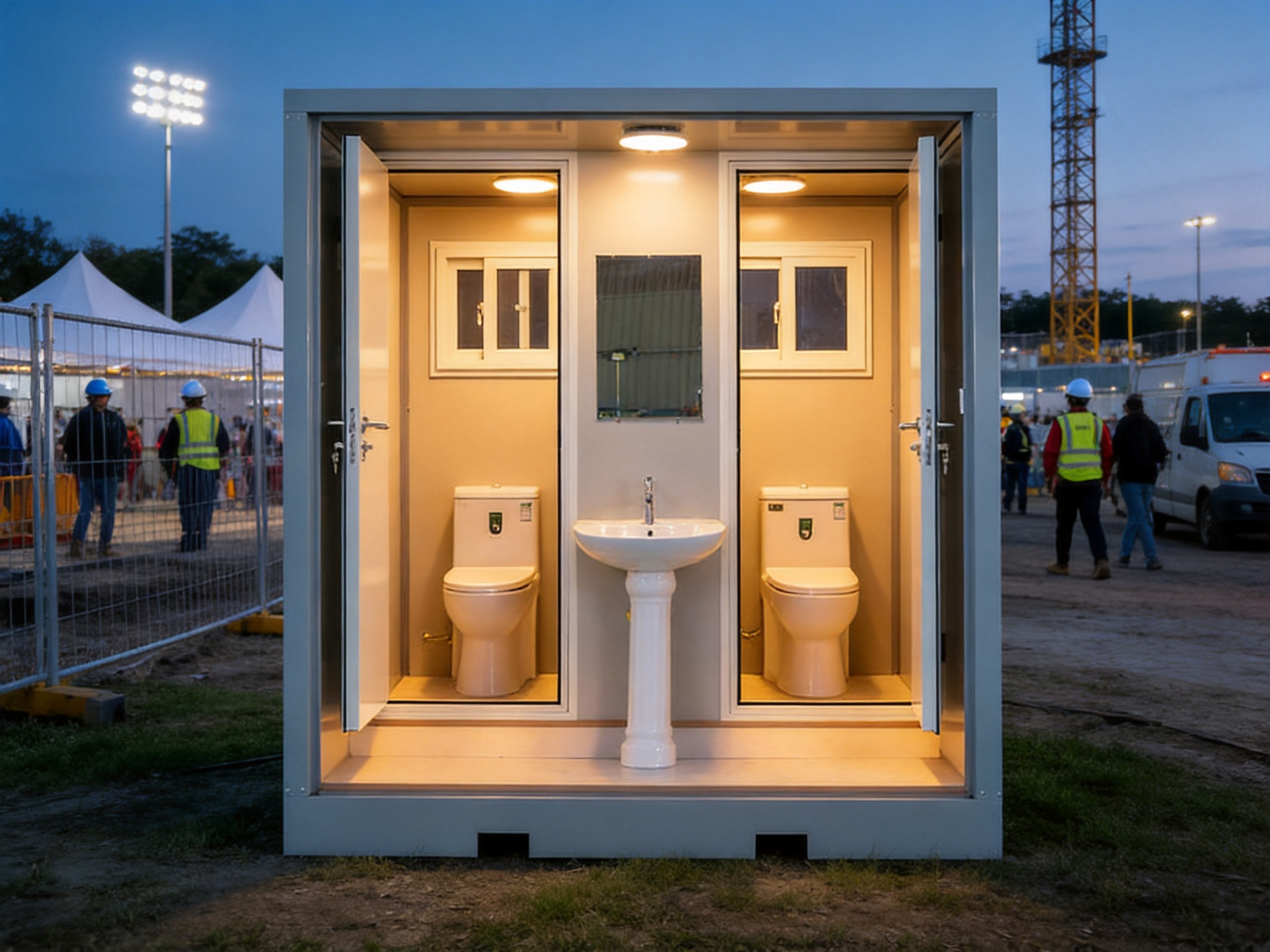
Outdoor facilities are often needed after sunset. Construction shifts may continue into the evening, events can run at night, and emergency operations may require sanitation access around the clock. Without lighting, users may have difficulty locating the facility, entering safely, identifying interior features, or washing their hands properly.
The Two-Person Outdoor Portable Toilet includes a built-in lighting system to support use during nighttime and low-light conditions. Integrated lighting is more convenient than requiring the operator to install a separate lamp or temporary electrical fixture around the restroom. It also helps create a more complete and consistent user experience.
Lighting can contribute to several operational benefits:
It improves visibility when users approach the unit after dark.
It helps users operate the facility more confidently in the evening.
It supports safer movement around entrances and interior areas.
It makes the restroom more practical for construction sites with extended shifts.
It supports emergency and disaster-relief use when normal public infrastructure may be unavailable.
Lighting should be considered as part of the restroom’s overall usability rather than as an optional decorative feature. A facility that can be used both during the day and at night provides greater value to organizers and site managers because it does not become unavailable when daylight ends.
External Handwashing Sink and Hygiene Support
Hand hygiene is a fundamental part of public sanitation. A toilet facility that does not provide a convenient place to wash hands may leave users searching for another water station after leaving the restroom. The external handwashing sink included with this unit places hygiene support directly beside the toilet compartments.
Because the sink is external, users can wash their hands after leaving the compartment without adding unnecessary congestion inside the restroom. It also allows the handwashing function to remain visible and accessible to users who may need to clean their hands before or after other activities at the site.
The sink is especially useful in locations such as:
Outdoor festivals and exhibitions where food, beverages, and public gathering areas are nearby.
Construction sites where workers may need to clean their hands before returning to shared facilities or vehicles.
Camping areas where permanent washrooms and plumbing systems may not yet be available.
Emergency-relief locations where hygiene infrastructure may be damaged or overloaded.
Temporary markets, sports events, fairs, and community activities where public health and convenience are important.
Including the sink as part of the unit can also simplify site planning. The operator does not necessarily need to source a separate portable washstand and coordinate its placement with the restroom. A combined solution can reduce the number of individual items that must be delivered, installed, inspected, and maintained.
Hygiene as an Operational Requirement
Good hygiene design is not limited to the presence of a toilet. Users also need a practical way to clean their hands. The combination of restroom compartments, an external sink, and built-in lighting creates a more complete sanitation station than a basic enclosed toilet without supporting facilities.
Operators should still establish an appropriate maintenance schedule, provide consumables where required, and follow local sanitation procedures. The product supports hygienic operation, but proper cleaning, waste handling, water management, and inspection remain essential parts of responsible use.
Robust Construction for Outdoor Environments
Portable restrooms are moved, installed, and used in environments that can be demanding. They may be exposed to sunlight, wind, rain, dust, mud, temperature changes, and repeated foot traffic. A facility intended only for indoor use would not be suitable for these conditions. The Two-Person Outdoor Portable Toilet is designed with a robust and stable structure for outdoor operation and frequent relocation.
Structural stability is important for user confidence. A restroom should feel secure when people enter, close a door, move inside, and exit. It should also remain suitable for use after transport to a new location, provided that it is positioned and installed correctly according to the supplier’s instructions and local site conditions.
Durability also affects the total operating cost. A unit that can be used repeatedly across different events or projects may provide better long-term value than a low-cost facility intended for one short deployment. Reusability can reduce the need to purchase or rent replacement units for every new site.
The portable design is particularly useful for customers whose needs change over time. A construction company may move the facility as a project progresses. An event organizer may transport it from one venue to another. A relief organization may deploy it where sanitation demand is highest and later relocate it as the emergency response develops.
Pre-Assembled Design and Quick Deployment
Time is often a critical factor in temporary construction. Customers may receive short notice of an event, need to open a construction area quickly, or respond to an emergency in which sanitation facilities are urgently required. Traditional restroom construction can involve site preparation, foundation work, plumbing, electrical installation, interior finishing, inspections, and coordination among multiple contractors.
The Two-Person Outdoor Portable Toilet is pre-assembled to reduce the amount of work required at the destination. Instead of building the restroom from separate structural components, the customer receives a prepared unit that can be positioned and made ready for operation within a short period, subject to site utilities, local regulations, and the specific installation method.
Quick deployment offers several advantages:
It reduces the waiting period before the facility becomes available.
It lowers the need for specialized construction labor at the destination.
It simplifies coordination among transport, site management, and installation teams.
It supports fast responses during urgent or emergency situations.
It allows event organizers to focus on other preparation tasks rather than constructing a restroom from the ground up.
It can reduce disruption to an active construction site or public venue.
Pre-assembly also provides greater consistency. Components are prepared and integrated under controlled factory conditions rather than being fitted entirely outdoors. This can help improve dimensional consistency, finishing quality, and inspection efficiency.
Portable Does Not Mean Incomplete
Some temporary facilities are portable because they contain only the minimum elements needed for basic use. This product takes a broader approach by combining two compartments, lighting, a handwashing sink, and a stable outdoor structure in one coordinated unit. Its portability is therefore paired with functionality.
The result is a facility that can be transported without being treated as a temporary compromise. It is intended to provide a practical level of convenience while remaining flexible enough for changing sites and short-term projects.
Applications Across Different Industries
Construction Sites
Construction workers need accessible sanitation facilities throughout the workday. A toilet located too far from the active work area can waste time and encourage unsafe or unhygienic practices. The portable unit can be placed near a site office, worker accommodation area, infrastructure project, roadwork zone, or building site.
As construction advances, the unit can be moved to maintain convenient access. This flexibility is valuable when excavation, structural work, vehicle traffic, or material storage changes the layout of the site. The separate compartments can also support a more organized facility for a mixed workforce.
The built-in lighting is helpful for projects with early-morning or evening shifts. The external sink supports handwashing after restroom use and can contribute to a cleaner work environment when managed with suitable water and waste arrangements.
Outdoor Events
Festivals, fairs, exhibitions, concerts, sporting events, weddings, and community gatherings often need temporary restrooms that can be installed without permanent construction. The Two-Person Outdoor Portable Toilet can be positioned near entrances, activity zones, refreshment areas, or staff facilities.
Its dual-compartment format can help improve visitor flow during busy periods. The lighting supports evening events, while the external sink contributes to public hygiene. After the event, the unit can be removed or transported to the next venue instead of remaining as a permanent structure.
Event operators should consider the number of expected users, event duration, cleaning frequency, access for service personnel, and local health regulations when determining how many facilities are required. The product is a practical component of an overall sanitation plan rather than a substitute for capacity planning.
Camping Areas and Outdoor Recreation
Remote campsites and recreational locations may not have access to permanent restroom buildings. A portable unit can provide a more organized sanitation point for campers, staff, visitors, and temporary accommodation areas.
Its outdoor-ready construction is appropriate for locations where the facility may remain exposed to changing weather. The sink is useful for maintaining basic hygiene at sites where users may otherwise need to walk to a separate washing area. Lighting provides additional convenience for nighttime access.
Emergency and Disaster Relief
After floods, earthquakes, storms, infrastructure failures, or other emergencies, existing sanitation systems may be damaged or overwhelmed. Temporary toilets can help support displaced residents, rescue personnel, medical teams, volunteers, and logistics workers.
Rapid deployment is especially important in these situations. A pre-assembled facility can be transported to the required location and prepared for use without waiting for a permanent building project. Its two compartments and integrated handwashing station can help establish a more organized sanitation area during the early stages of recovery.
Relief agencies must evaluate access roads, ground conditions, waste treatment, water availability, power requirements, cleaning procedures, and public health standards before deployment. The product’s portable format can support these operations, but effective emergency sanitation always depends on proper planning and management.
Temporary Housing and Worker Accommodation Areas
Although the Two-Person Outdoor Portable Toilet is not a living unit, it can complement temporary housing, worker camps, modular buildings, and container-based accommodation. It provides a dedicated sanitation facility without requiring every accommodation unit to include a complete bathroom.
This can be useful during the early stages of a construction project, in temporary labor quarters, or at locations where housing modules are installed before permanent utility infrastructure is completed.
Advantages Compared with Basic Portable Toilets
Customers comparing portable sanitation products often focus on price, but the lowest initial purchase cost does not always represent the best value. A facility must also be evaluated according to capacity, usability, transport requirements, hygiene support, nighttime operation, durability, and the amount of site work required.
The Two-Person Outdoor Portable Toilet offers several design advantages over a basic single-compartment portable toilet.
| Evaluation Area | Basic Single Portable Toilet | Two-Person Outdoor Portable Toilet |
|---|---|---|
| Compartment arrangement | Usually one user compartment | Separate male and female compartments |
| Simultaneous use | Generally limited to one user | Supports two users at the same time |
| Handwashing | May require a separate station | Includes an external handwashing sink |
| Nighttime convenience | May depend on external lighting | Includes a built-in lighting system |
| Deployment | May require additional accessories or site preparation | Pre-assembled for rapid setup |
| Relocation | Portable, but features may be limited | Designed for transport and repeated relocation |
| Typical use case | Short-duration, low-demand applications | Events, construction, camping, and emergency operations |
The comparison does not mean that one product is suitable for every project. A very small event may need only a basic unit, while a larger or longer-running operation may benefit from additional features. The value of this two-person model lies in combining capacity and supporting functions in one portable structure.
Advantages Compared with Permanent Restroom Construction
Permanent restroom buildings can provide excellent long-term service, but they require more time, capital, planning, and land preparation. Construction may involve architectural design, foundations, utility connections, drainage, electrical work, plumbing, ventilation, finishes, permitting, and ongoing building maintenance.
A portable restroom is more appropriate when the need is temporary, the site is changing, or construction time is limited. The Two-Person Outdoor Portable Toilet does not eliminate the need to comply with local building and sanitation requirements, but its pre-assembled format can reduce the complexity of deployment.
It can be advantageous when:
The site will be used for a limited period.
The customer expects the restroom to move as work progresses.
A permanent building would take too long to complete.
The location does not justify permanent construction investment.
An event needs a facility that can be removed after use.
An emergency requires a sanitation response before infrastructure can be rebuilt.
For these scenarios, portability and speed may be more important than creating a fixed building. The unit offers a practical middle ground between a minimal single toilet and a fully constructed restroom building.
Manufacturing Strengths of Suzhou Taimao Integrated Housing Co., Ltd.
Suzhou Taimao Integrated Housing Co., Ltd. is a China-based manufacturer and supplier of integrated housing and modular building solutions. Its product range includes assembled container houses, folding container houses, double-wing expandable container houses, portable restroom outdoor toilets, K-type prefabricated houses, and steel structures.
The company’s broader manufacturing experience is relevant to the production of portable sanitation units. A portable toilet is not simply a collection of panels. It requires coordinated structural fabrication, enclosure assembly, electrical integration, interior finishing, transport consideration, and quality control. Experience with modular and prefabricated buildings can support a systematic approach to these requirements.
The company describes its manufacturing and design capabilities as covering modular design, proprietary manufacturing technologies, and end-to-end digital software support. It also presents a mission focused on accelerating project timelines, improving operational efficiency, reducing ecological impact, and maintaining quality and safety standards.
Factory-Based Integration
Factory-based production can offer important benefits compared with building every part at the project site. Components can be prepared in a controlled environment, where workers have access to appropriate tools, repeatable procedures, material-handling equipment, and inspection checkpoints.
For a portable restroom, factory integration may include:
Structural frame preparation and assembly.
Wall, roof, and floor component fitting.
Door and compartment installation.
Lighting system integration.
Handwashing sink installation.
Interior and exterior finishing.
Functional checks before shipment.
Packaging and transport preparation.
Factory assembly can reduce exposure to rain, dust, uneven ground, and other variables that affect outdoor construction. It can also improve consistency between units ordered for a larger project or recurring event program.
Modular Design Experience
The company’s focus on modular buildings supports a design philosophy based on standardized components, efficient assembly, and transportable structures. These principles are directly relevant to portable sanitation. A modular product should be easy to manufacture repeatedly, practical to ship, straightforward to install, and adaptable to different site conditions.
Modular thinking also helps manufacturers organize product development. Structural components, electrical elements, sanitary fixtures, and finishing materials can be reviewed as parts of a coordinated system rather than as unrelated items. This reduces the risk that one feature will interfere with another during installation or operation.
Integrated Building Technology
According to the provided company information, Suzhou Taimao Integrated Housing Co., Ltd. develops SIP-based modular building systems that integrate structure, insulation, MEP systems, HVAC, interior finishes, and smart-home technologies into a unified solution. A portable outdoor toilet has different functional requirements from a residential modular building, but the same general capability in integrated design is valuable.
Electrical lighting, structural components, enclosure materials, access arrangements, and sanitation equipment must work together. When these systems are integrated during production, the final unit can be delivered in a more complete condition than a product requiring extensive on-site coordination.
Production Process for a Portable Restroom Unit
The exact production sequence may vary according to configuration, order quantity, material selection, and destination requirements. A typical factory-based process for a product of this type can be organized into several stages.
Design and Technical Review
The process begins with a review of the intended application. The manufacturer considers the number of compartments, user flow, access points, lighting arrangement, sink position, structural requirements, transport limitations, and expected operating environment.
For export projects, technical discussions may also address destination standards, electrical requirements, climate conditions, packaging, shipping dimensions, and local installation practices. This stage helps ensure that the product is appropriate for the customer’s intended use before materials are committed.
Material Preparation
Structural materials, enclosure panels, doors, flooring components, lighting elements, and sanitary fixtures are prepared according to the production plan. Material preparation should include dimensional checks and visual inspection to reduce the chance of defects entering the assembly line.
Good material organization is important for modular manufacturing. When components are clearly identified and arranged, assembly teams can work more efficiently and reduce installation errors.
Frame Assembly
The structural frame forms the basis of the unit. It must support the walls, roof, doors, interior partitions, fixtures, and transportation loads. The frame is assembled according to the approved design, with attention to alignment, connection quality, and overall stability.
A strong frame is particularly important for a portable product because the unit may experience lifting, loading, unloading, road vibration, and repeated relocation. The design must account for both normal use and movement between sites.
Enclosure and Partition Installation
Wall and roof components are fitted to the frame, followed by interior partitions that create the separate male and female compartments. Doors and access elements are installed and checked for proper operation.
Enclosure assembly contributes to privacy, weather resistance, user comfort, and the overall appearance of the facility. Properly fitted components can also help reduce maintenance issues caused by water penetration, loose panels, or misaligned doors.
Electrical and Lighting Integration
The built-in lighting system is installed as part of the integrated production process. Electrical components should be positioned and protected in accordance with the applicable design and safety requirements. The system is checked before shipment to confirm that the lighting operates as intended.
Customers should confirm power supply requirements, connection methods, and local electrical compliance during the purchasing process. The presence of an integrated lighting system improves convenience, but the final installation must always be handled responsibly and according to relevant regulations.
Sink and Sanitation Fixture Installation
The external handwashing sink is installed in a location that is accessible to users and practical for service personnel. Connections, drainage arrangements, and water supply requirements depend on the customer’s selected configuration and site conditions.
Factory installation can help ensure that the sink is securely positioned and coordinated with the surrounding structure. Before use, the customer should verify the water supply, drainage, waste collection, and cleaning procedures applicable to the location.
Finishing and Quality Inspection
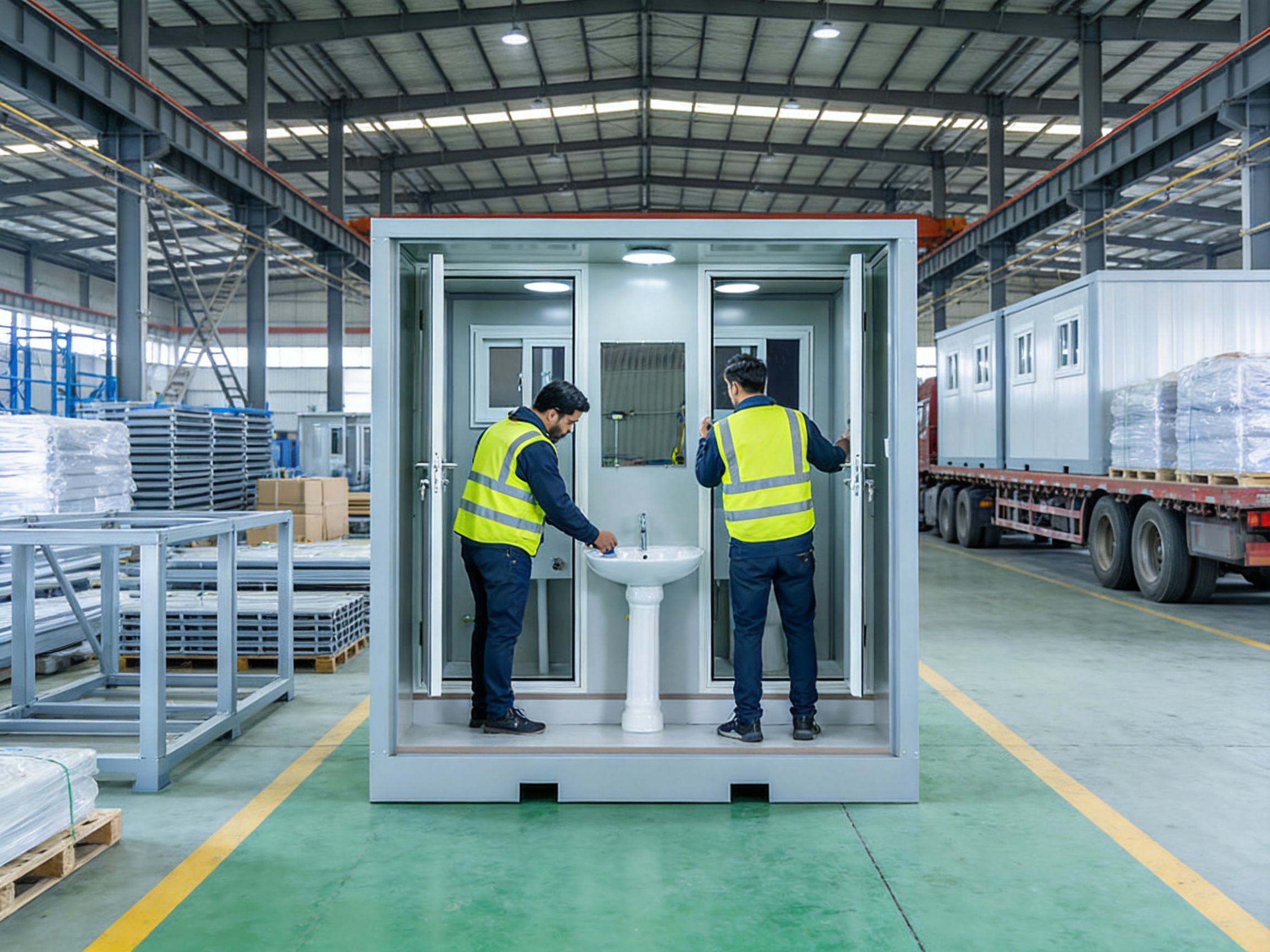
After the main assembly is complete, finishing work is performed. This may include surface treatment, edge inspection, fixture adjustment, cleaning, labeling, and final appearance checks. The unit is then inspected for structural integrity, compartment functionality, lighting operation, door movement, sink installation, and general readiness.
Pre-shipment inspection is an important advantage of factory production. Identifying and correcting problems before delivery is usually more efficient than discovering them after the unit has arrived at a remote site or event venue.
Quality Control and Delivery Preparation
Quality control should continue throughout production rather than occurring only at the end. A systematic approach may include incoming material checks, assembly inspections, process verification, electrical testing, fixture checks, and final review.
For portable products, transport preparation is also part of quality assurance. The unit must be protected during handling and shipping. Doors, lighting components, sink fittings, and finished surfaces may require suitable protection against impact, movement, moisture, and abrasion.
The manufacturer’s experience with container houses, steel structures, and prefabricated units can support efficient logistics planning. These product categories require consideration of lifting points, shipping dimensions, loading methods, site access, and installation sequence. Similar considerations apply to portable restroom delivery.
Customers purchasing for multiple locations may benefit from standardized documentation, consistent assembly procedures, and repeatable product specifications. These factors can make it easier to train site personnel and establish uniform maintenance practices.
Environmental and Efficiency Considerations
Portable sanitation can support more efficient use of land and materials when it replaces temporary construction that would otherwise be demolished after a short period. A reusable unit can be transported between projects, allowing the same structure to serve multiple locations over its service life.
Factory production can also help manage material use by organizing cutting, assembly, and finishing in a controlled environment. Reduced on-site construction may lower the amount of temporary waste generated at the destination. However, environmental performance depends on material selection, transportation distance, maintenance, waste management, water use, and end-of-life handling.
The company’s stated focus on minimizing ecological impact and improving operational efficiency reflects a broader direction in modern prefabricated construction. Integrated manufacturing can support more predictable production, shorter site activity, and better control over resource use.
Customers seeking a sustainable sanitation solution should evaluate the complete operating cycle. Important questions include how often the unit will be reused, how it will be transported, what cleaning products will be used, how wastewater will be managed, and whether components can be repaired or replaced rather than discarded.
How the Unit Supports Different Project Sizes
The Two-Person Outdoor Portable Toilet can be used as a single facility or as part of a larger temporary sanitation arrangement. A small construction site may need one unit, while a large festival may require multiple units positioned at different points around the venue.
Multiple units can help distribute users and reduce walking distances. They can also be assigned to different zones, such as public areas, staff areas, backstage areas, worker accommodation zones, or emergency medical locations.
For larger orders, the manufacturer may be able to coordinate production schedules, standardized configurations, packaging, and delivery planning. Buyers should communicate expected quantities, preferred features, destination countries, project timelines, and local compliance needs early in the procurement process.
Using a repeatable unit design can simplify planning for organizations that manage recurring events or multiple construction projects. The same general operating procedures can be applied to each location, while site-specific utility and access requirements are reviewed before deployment.
Installation and Site Planning Considerations
Although the unit is pre-assembled and designed for quick deployment, appropriate site planning remains essential. The selected location should be stable, accessible, and suitable for the unit’s intended use. It should not obstruct emergency routes, vehicle movement, pedestrian access, drainage paths, or other critical site functions.
Operators should consider the following points before delivery:
Whether the ground is sufficiently level and stable.
Whether transport vehicles can reach the installation location.
Whether lifting or unloading equipment is required.
How users will approach the facility safely.
Where wastewater, waste containers, and cleaning equipment will be managed.
How the lighting system will receive power.
How the sink will receive water and discharge used water.
How frequently the unit will be cleaned and inspected.
Whether local permits or health approvals are required.
A well-planned site improves user experience and reduces operational problems. The manufacturer or distributor should receive accurate information about the intended application so that transportation and installation arrangements can be prepared correctly.
Maintenance and Long-Term Use
Regular maintenance helps preserve cleanliness, appearance, safety, and service life. A maintenance program should include cleaning both compartments, checking doors and hardware, inspecting lighting, maintaining the sink, reviewing structural components, and removing waste according to local requirements.
The cleaning frequency depends on the number of users, duration of operation, environmental conditions, and type of application. A busy event may require service several times per day, while a lightly used private construction site may follow a different schedule.
Lighting should be checked regularly, especially before nighttime operation. Sink connections and drainage should be inspected for leaks or blockages. Exterior surfaces should be cleaned using methods compatible with the selected materials and finishes.
When the unit is relocated, operators should inspect it after transport. Doors, panels, fixtures, connections, and structural points should be checked before users are allowed to enter. Early identification of transport-related damage can help prevent larger repairs later.
Operational Responsibility
A high-quality portable restroom still requires responsible management. Users need clear access, adequate cleaning, waste removal, and supplies. Site managers should also consider accessibility needs and ensure that the facility is positioned in compliance with applicable laws and project requirements.
The product provides the physical sanitation structure, while the customer’s operating plan determines how effectively it performs in practice.
How to Choose a Supplier
When purchasing a portable restroom, buyers should evaluate more than product photographs. A capable supplier should be able to discuss structure, materials, electrical systems, sanitation arrangements, transport, customization, manufacturing lead time, and after-sales support.
Important supplier evaluation questions include:
Does the manufacturer have experience with prefabricated and modular structures?
Can the supplier provide clear product specifications and installation guidance?
Are quality-control procedures applied during production?
Can the supplier coordinate export packaging and delivery?
Can the unit be adapted to destination electrical or sanitation requirements?
Does the company understand repeated relocation and outdoor operation?
Can the supplier support projects requiring multiple units?
Is technical communication available before and after purchase?
Suzhou Taimao Integrated Housing Co., Ltd. offers a product portfolio that includes several types of modular and prefabricated structures. This broader capability can be useful for customers seeking coordinated temporary facilities, such as portable toilets alongside container offices, worker accommodation, site guard rooms, or other prefabricated buildings.
Customization and Project Coordination
Temporary projects often have different requirements. A construction site may prioritize durability and repeated relocation. An event organizer may focus on appearance, user flow, and nighttime access. An emergency-relief project may emphasize rapid delivery and practical sanitation support.
Customization discussions can address layout, finishes, signage, electrical arrangements, sink configuration, transportation, and quantity. Any modification should be reviewed for its effect on structural performance, manufacturing time, shipping, maintenance, and local compliance.
Project coordination is especially important for international customers. The buyer should provide the destination, intended use, climate, power conditions, delivery schedule, unloading capability, and relevant regulations. Clear information allows the supplier to recommend a more suitable configuration and reduce misunderstandings during production.
Frequently Asked Questions
What is the main purpose of this product?
The Two-Person Outdoor Portable Toilet provides a compact, mobile sanitation facility for outdoor events, construction sites, camping areas, emergency operations, and other temporary applications.
Why is it called a two-person toilet?
The unit contains two independent restroom compartments, allowing two users to access the facility at the same time. The compartments are arranged as separate male and female facilities.
Does the unit include a handwashing station?
Yes. The product includes an external handwashing sink to support hygiene and convenience after restroom use.
Can it be used at night?
Yes. A built-in lighting system is included for nighttime and low-light operation. The customer should confirm the required power connection and local electrical conditions before installation.
Is the portable toilet delivered assembled?
The unit is pre-assembled for quick deployment. Final placement, utility connection, inspection, and preparation for use depend on the destination site and the selected configuration.
Can the unit be moved to another location?
Yes. Its portable construction is intended to support transport and relocation. The unit should be handled with appropriate equipment and inspected after every move.
Where can this product be installed?
It can be used at construction sites, outdoor events, camping areas, temporary accommodation zones, emergency-relief locations, and other suitable outdoor sites. The installation location must meet local safety, sanitation, access, and utility requirements.
Is it suitable for a large festival?
It can be used as one part of a larger festival sanitation plan. The number of units required depends on attendance, event duration, local requirements, cleaning frequency, and the availability of other facilities.
How does it compare with a single-cabin portable toilet?
It provides two independent compartments, an external handwashing sink, and built-in lighting in one integrated structure. These features can improve capacity, privacy, hygiene, and nighttime usability compared with a more basic single-cabin unit.
Is it a replacement for a permanent restroom building?
It is designed primarily for temporary or mobile sanitation needs. It may be a more practical choice than permanent construction when the site is temporary, changing, remote, or urgently needed, but permanent facilities may remain more appropriate for long-term fixed developments.
What maintenance does it require?
Maintenance includes regular cleaning, waste management, sink inspection, lighting checks, door and hardware inspection, and structural review. The frequency depends on user volume and operating conditions.
Can the manufacturer supply other temporary buildings?
Suzhou Taimao Integrated Housing Co., Ltd. also supplies assembled container houses, folding container houses, double-wing expandable container houses, K-type prefabricated houses, and steel structures. This allows customers to discuss coordinated solutions for broader temporary construction requirements.
What should buyers provide when requesting a quotation?
Buyers should provide the required quantity, destination, intended application, delivery schedule, preferred configuration, available utilities, unloading conditions, and any local technical or regulatory requirements. This information helps the supplier prepare an accurate proposal.
Conclusion
The Two-Person Outdoor Portable Toilet is designed for customers who need a reliable sanitation facility without the time and cost of permanent restroom construction. Its two independent compartments provide privacy and simultaneous use, while the built-in lighting and external handwashing sink improve convenience and hygiene.
Its pre-assembled design supports rapid deployment, and its robust portable structure allows it to serve changing construction sites, temporary events, campsites, and emergency operations. Compared with a basic single portable toilet, it offers a more complete set of functions in one coordinated unit. Compared with permanent construction, it provides greater flexibility when the need is temporary or the site is subject to change.
The product also benefits from the manufacturing capabilities of Suzhou Taimao Integrated Housing Co., Ltd., a supplier with experience in modular buildings, prefabricated structures, container houses, and steel construction. The company’s emphasis on integrated design, factory production, digital support, operational efficiency, and controlled manufacturing provides a foundation for producing practical portable facilities.
For organizations seeking a mobile restroom solution, the most important considerations are usability, privacy, hygiene, durability, deployment speed, transportation, and long-term maintenance. By combining these requirements in a compact dual-compartment structure, the Two-Person Outdoor Portable Toilet offers a flexible sanitation option for modern temporary projects.
References
1. Suzhou Taimao Integrated Housing Co., Ltd. Product information for the Two-Person Outdoor Portable Toilet.
2. Suzhou Taimao Integrated Housing Co., Ltd. Company information on modular design, prefabricated construction, and integrated manufacturing.
3. International Organization for Standardization. General principles for quality management and controlled manufacturing processes.
4. World Health Organization. Guidance on sanitation, hygiene, and handwashing in public and emergency settings.
5. International Labour Organization. General principles for welfare facilities and sanitation in construction workplaces.
6. International Federation of Red Cross and Red Crescent Societies. Emergency sanitation and temporary settlement support principles.
Product: Two-Person Outdoor Portable Toilet

For exclusive deals and latest offers, sign up by entering your email address below.

-
TEL:+86 18762912902
-
Email:cntaimao@163.com
-
WhatsApp:
-
Add:Group 5, Cao Village, Zhenze Town, Suzhou, Jiangsu, China
Copyright © Suzhou Taimao Integrated Housing Co., Ltd.
All Rights Reserved.
 Wholesale movable homes for sale
custom built modular homes
Wholesale movable homes for sale
custom built modular homes